
Marketing ROI Tracking for Local Service Businesses
Sam McKinney
Founder & Lead Strategist • September 15, 2026
Overview
Marketing ROI tracking works when every lead source connects to qualified opportunities and closed revenue. Build a practical measurement system for calls, forms, CRM stages, and smarter budget decisions.
Marketing ROI tracking for a local service business means connecting each marketing cost to the qualified leads, booked jobs, and revenue it helped produce. Website traffic and form counts are useful diagnostics, but they are not return. Return becomes measurable only when the marketing record and the sales record meet.
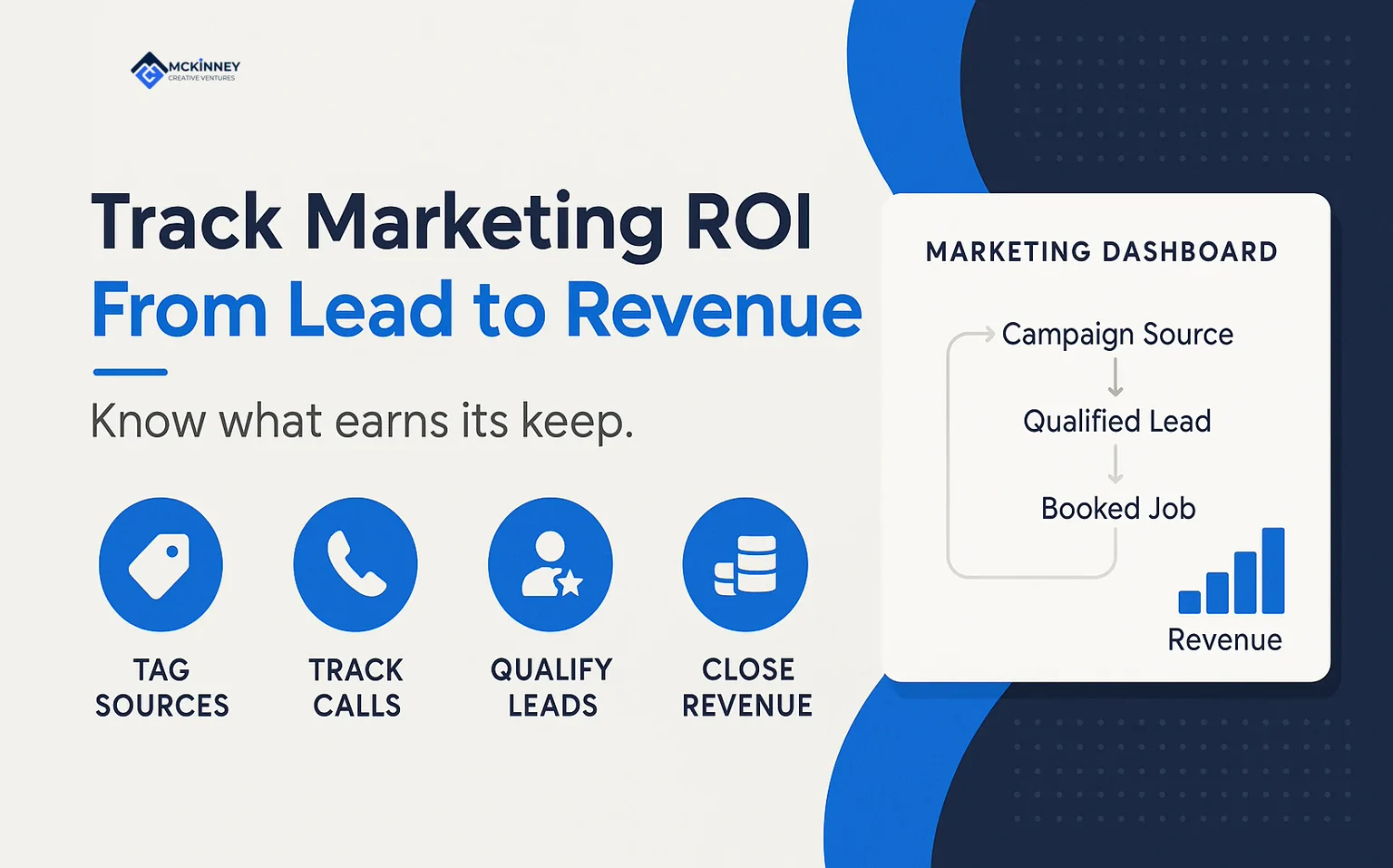
The practical system is smaller than most reporting stacks. Tag the source, capture calls and forms, move every real opportunity through a consistent CRM pipeline, record the value of won work, and review the same few numbers every month. That gives an owner enough evidence to cut waste, protect productive channels, and improve the weak handoffs between attention and revenue.
Marketing ROI tracking starts with one honest formula
The basic formula is simple: subtract marketing cost from the financial return attributed to that marketing, divide by marketing cost, then multiply by 100. The difficult part is deciding what belongs in the return number.
Revenue is easy to find, but it can exaggerate performance when job margins vary. A $10,000 project with heavy material and subcontractor costs is not equal to $10,000 of high-margin service work. If your accounting is reliable, use gross profit from won jobs. If it is not, start with collected revenue and label the metric honestly as a revenue return or return on ad spend. Do not call every revenue ratio profit.
| Metric | Formula | What it answers | Common mistake |
|---|---|---|---|
| Cost per lead | Marketing cost divided by leads | How much did each inquiry cost? | Counting spam, wrong numbers, and job applicants as leads |
| Cost per qualified lead | Marketing cost divided by qualified leads | How much did each real opportunity cost? | Using different qualification rules by channel |
| Customer acquisition cost | Marketing and sales cost divided by new customers | What did it cost to win a customer? | Ignoring agency fees, software, or sales labor |
| Revenue return | Attributed revenue divided by marketing cost | How much revenue came back per dollar spent? | Calling revenue profit |
| Marketing ROI | (Attributed gross profit minus marketing cost) divided by marketing cost | Did the campaign create profit after its cost? | Using estimates when closed-job values exist |
Pick one financial definition and keep it stable. Changing the formula whenever a channel looks weak turns reporting into a defense exercise. A consistent, imperfect model is more useful than a perfect-looking dashboard built from shifting rules.
Build the measurement chain before choosing a dashboard
A dashboard cannot reconnect data that was never captured. The measurement chain begins at the first identifiable source and ends when a job is won, lost, or disqualified. Every link needs a shared identifier, a timestamp, or a consistent campaign label that lets the next system recognize the same opportunity.
- Source: Record how the prospect arrived, such as organic search, Google Ads, referral, email, direct mail, or a partner.
- Lead: Capture the call, form, chat, or booking with the source data attached.
- Qualification: Decide whether the request matches your service, geography, timing, and minimum job requirements.
- Opportunity: Track the estimate, consultation, inspection, or next sales step in one pipeline.
- Outcome: Mark the opportunity won or lost and record the collected or contracted value using one rule.
Google Analytics can show where website sessions originated through source, medium, campaign, and channel dimensions. Google's Traffic acquisition documentation also distinguishes session acquisition from first-user acquisition. That distinction matters because the channel that first introduced a customer may differ from the channel that brought the customer back to convert.
Analytics is the behavior layer, not the final sales ledger. Use it to understand visits and key actions. Use your CRM and automation system to determine which inquiries became qualified opportunities and which opportunities produced work.
Track calls and forms as leads, then qualify them
Local service businesses often close work by phone, which makes click-only reporting incomplete. A tap on a phone number proves intent, but it does not prove that the call connected, reached the right person, or became a sale. Call tracking should capture the source, call time, duration, recording or disposition when legally and operationally appropriate, and the contact record created from the conversation.
Google Ads supports several forms of phone conversion measurement, including calls from ads, calls to a number on a website, mobile number clicks, and imported call outcomes. Its phone call conversion guidance explains that website call tracking can use a forwarding number and that imported call conversions can reflect sales recorded in another system. The second method is more meaningful when call length alone does not identify a good lead.
Forms need the same discipline. Capture the landing page, source, medium, campaign, timestamp, and the service requested. Preserve the original source when the lead moves into the CRM. Then add a qualification result that staff can apply consistently.
Use a short lead-quality vocabulary
- Qualified: Real prospect, correct service area, relevant service, and a plausible path to purchase.
- Unqualified: Real inquiry, but outside the service, geography, budget, or timing you accept.
- Invalid: Spam, solicitation, duplicate, job applicant, wrong number, or test.
- Unreached: A potentially valid person you have not yet contacted.
Do not force unreached leads into unqualified just to clean up a report. That hides a response problem inside a marketing metric. If the lead was never contacted, the channel has not had a fair sales test.
Use campaign tags that a human can maintain
UTM tags help analytics distinguish links from email, social, sponsorships, directory listings, and other campaigns. Their value depends on naming consistency. If one person uses facebook, another uses fb, and a third uses Facebook.com, the report splits one source into three rows.
Create a short naming standard before launching campaigns. Keep source for the platform or publisher, medium for the channel type, and campaign for the initiative. Use lowercase values, choose one separator, and maintain a shared campaign register. Never put personal information in a URL tag because URLs can appear in browser history, analytics, and server logs.
| Field | Purpose | Good example | Avoid |
|---|---|---|---|
| utm_source | Platform or publisher | google, facebook, chamber | Mixing fb and facebook |
| utm_medium | Channel type | cpc, email, referral | Using a campaign name here |
| utm_campaign | Specific initiative | fall-furnace-tuneup | Names that change mid-campaign |
| CRM source | Operational reporting category | Paid Search | Free-text entries for every lead |
| Lead detail | Granular evidence | Campaign and landing page | Overwriting the original source |
For offline materials, use a dedicated landing page, trackable phone number, QR code, or offer code. The method matters less than keeping the identifier attached until the job outcome is known.
Close the loop from CRM revenue back to the channel
The most damaging gap is usually between a lead platform and the CRM. Ad platforms celebrate submitted forms. The business earns money only when qualified work closes and gets collected. Connect those records so the campaign can be judged on business value, not just activity.
Google recommends sending values from qualified or closed offline leads through enhanced conversions for leads when those values live in a CRM. Its conversion value guidance explains that transaction-specific values are appropriate when sales have different values. This is especially relevant for service companies where a maintenance visit and a major replacement can arrive through the same campaign.
Start with the CRM even if an automated upload is not ready. Require four fields on every closed opportunity: original source, campaign when known, won or lost status, and job value. Add a loss reason from a controlled list. A monthly export with clean values is more useful than a live integration that quietly drops errors.
If paid media is part of the mix, digital advertising management should optimize toward qualified and won outcomes whenever the platform has enough reliable data. Optimizing toward every form submission teaches the system to find more forms, including cheap requests the business cannot serve.
Review a small scorecard every month
A useful owner scorecard fits on one page. Break it out by channel and campaign, but keep the definitions identical across rows. Review spend, valid leads, qualified leads, won customers, collected or contracted revenue, gross profit if available, and the resulting acquisition cost and return.
Also track response time and contact rate. Marketing can create a qualified inquiry that operations never reaches. Separating channel quality from follow-up performance prevents the business from canceling good demand because the handoff failed.
Ask these questions in order
- Is the source data complete enough to trust?
- Did the channel produce valid and qualified opportunities?
- Were those opportunities contacted and worked consistently?
- Did they close, and at what value and margin?
- What single change should be tested next month?
A service website is part of this system, not a separate creative asset. Its forms, calls, booking actions, and landing pages need measurement that survives the handoff into the sales process.
Know what attribution cannot prove
Attribution assigns credit using rules and available observations. It does not recreate every influence on a buyer. A customer may see a truck, hear a referral, read reviews, click an ad, return directly, and call from another device. Different platforms can each claim credit for the same sale because each sees a different part of that path.
Use attribution to improve decisions, not to manufacture certainty. Keep a visible bucket for unknown sources. Compare platform reports with CRM outcomes. Ask new customers how they heard about you, but treat the answer as another signal rather than perfect memory. When two sources disagree, investigate the collection rules before choosing the number you prefer.
Small businesses rarely need a complicated multi-touch model. They need reliable capture, consistent qualification, closed-job values, and enough humility to label unknowns. That foundation makes every later reporting improvement more useful.
Extended Recap & Conclusion
Marketing ROI tracking is an operating discipline, not a dashboard purchase. Begin with a stable financial definition. Capture the source on calls and forms. Qualify every real inquiry using the same rules. Move opportunities through one CRM pipeline, record won value, and review spend against qualified leads and closed work.
The goal is not perfect credit for every touchpoint. The goal is a trustworthy enough system to make the next budget decision. Protect channels that create profitable work, repair follow-up where good leads are being lost, and stop funding activity that never reaches a business outcome.
Frequently Asked Questions
What is a good marketing ROI for a local service business?
There is no universal target. A sustainable result depends on gross margin, sales capacity, repeat business, cash flow, and how quickly the investment returns. Set a target from your own economics, then compare channels with the same formula and time window.
Should I calculate marketing ROI from revenue or profit?
Use gross profit when reliable job-level margin data is available because it reflects more of the economic result. If you use revenue, label the metric as revenue return or return on ad spend so it is not mistaken for profit.
How should phone calls be included in marketing attribution?
Use call tracking that preserves the source, then connect the call to a CRM contact and final outcome. A phone-number click or long call can be an early conversion signal, but the qualified lead and closed job are stronger measures of business value.
Can Google Analytics calculate true marketing ROI by itself?
Usually not for a service business. Analytics can connect traffic sources to website behavior and key events, but closed-job value, qualification, phone outcomes, and sales costs often live in the CRM and accounting system. Those records must be reconciled.
How often should a small business review marketing ROI?
Review the operating scorecard monthly and monitor major campaigns more frequently for tracking failures or sudden waste. Use a longer decision window when sales cycles are slow or lead volume is low, so a few outcomes do not create false confidence.
If your leads, pipeline, and revenue live in separate reports, book a free strategy call. We will map the missing connection and identify the first measurement fix worth making.
Written by
Sam McKinney
Founder & Lead Strategist, McKinney Creative Ventures
Sam McKinney helps local service businesses across the Twin Cities East Metro and St. Croix Valley grow through connected marketing systems. Websites, SEO, CRM, and AI automation built to work together instead of in isolation.
More about MCVRelated Articles
Cottage Grove MN Marketing: How Local Service Businesses Get Found
Cottage Grove is growing, but growth does not automatically send the right customers to your door. Build a local marketing system that connects search visibility, useful city content, reviews, and fast follow-up.
Automated Review Generation: How to Build a System That Earns 5-Star Reviews
A review generation system turns your happy customers into a steady stream of 5-star Google reviews, automatically and within Google's rules. Here is how to build one for a local service business.
Ready to Grow Your Business?
Book a strategy call to discuss how we can implement these systems and strategies to help your business scale.
Book a Strategy Call