

Web marketing for small business works best when it is built in order: a website that converts, a verified Google Business Profile, local search pages, reviews, email to past customers, then paid search once those hold, with measurement running from the start. This guide is for owners of local service businesses in the Twin Cities East Metro, the St. Croix Valley and western Wisconsin who have a limited budget and want to know what to build first.
The order matters because each step sends people to the next one. Ads that land on a slow or unclear site waste the click, and reviews do little for a Business Profile nobody has verified. We cover each step with the rules and documentation behind it, and we keep this post to sequence. We leave costs and budgets to other posts.
Web marketing for small business: the order that works
The table lists the steps in the order we would build them, what each one does and when it counts as done. The sections after it give the sources.
Scroll to see all columns
| Step | What it does | Done when |
|---|---|---|
| 1. Website that converts | Gives every other channel a place to send people | A visitor can tell what you do, where you work and how to reach you at a glance |
| 2. Google Business Profile | Puts you in Maps and local results | The profile is verified, complete and matches the website |
| 3. Local SEO pages | Matches the searches customers make | Each service and each real service area has its own accurate page |
| 4. Reviews | Gives new customers proof from past ones | You ask after every job and reply to every review |
| 5. Email to past customers | Brings back people who already know you | A list of past customers and a few messages tied to your seasons, each with an opt-out and a postal address |
| 6. Paid search | Buys visibility while organic work builds | Conversions are tracked and the pages the ads land on are ready |
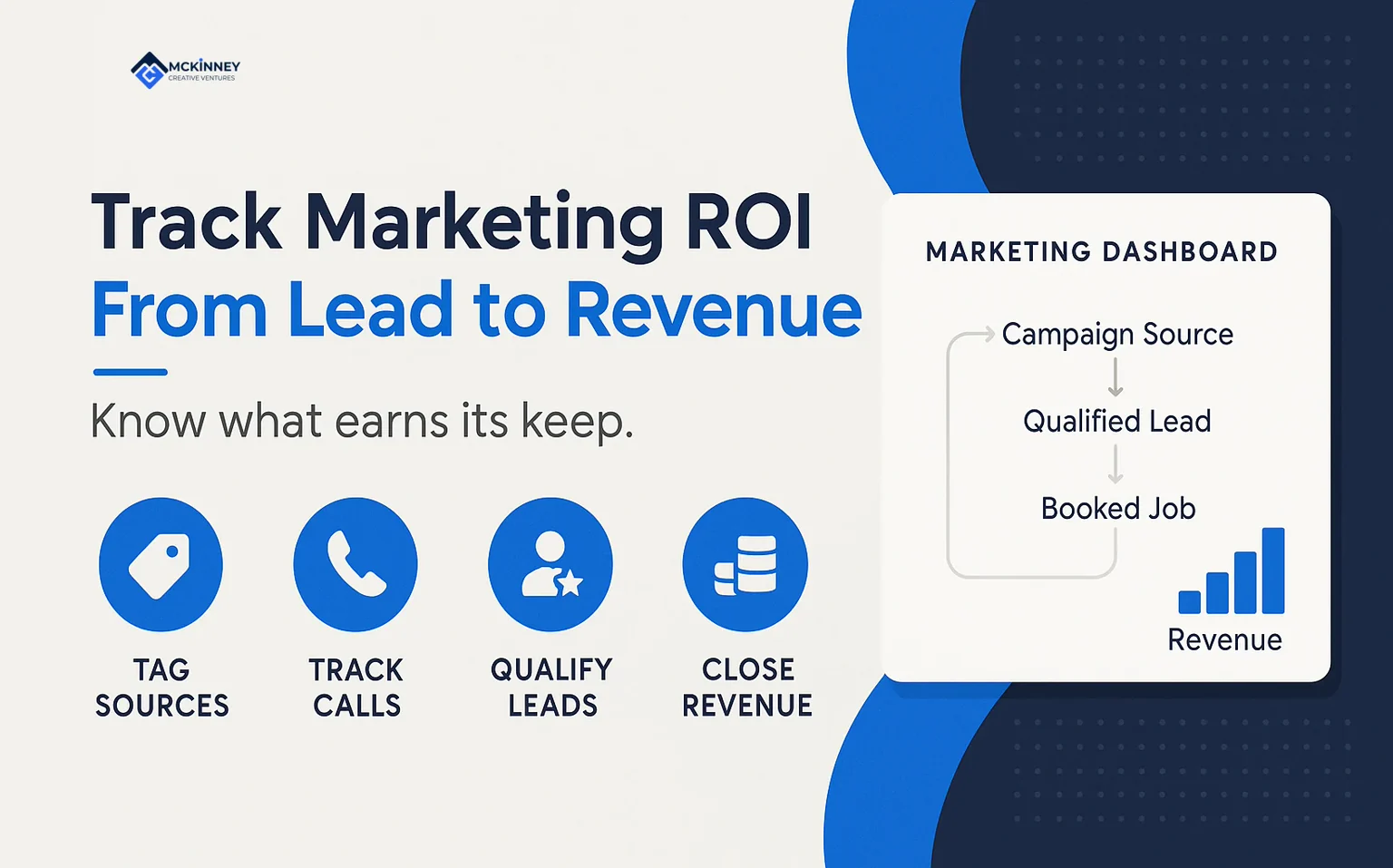
| 7. Measurement | Shows which steps produce calls and forms | Calls, form sends and bookings are counted by source |
Start with a website that converts
Google's SEO Starter Guide says that creating content people find compelling and useful will likely influence your site's presence in search results more than any other suggestion in the guide. It lists content that is easy to read and well organized, unique, up to date, and helpful and reliable. The same guide tells business owners to list the site's URL on business cards, letterhead and posters. The guide covers content for search. The phone test below is our own view on conversion.
A simple test is to open the homepage on a phone, look for five seconds, then look away. Could you say what the business does, who it serves, where it works and what to do next? If any of those takes longer than five seconds, fix that before spending on anything else. Then check the form. A site that sends leads to an inbox nobody reads loses them, and no later step fixes that. Our website design and rebuild service covers the build, hosting and ongoing management, and our post on marketing systems for a local service business shows how the pieces connect.
Claim and complete your Google Business Profile
Google's page on improving your local ranking says verifying your business tells Google you are authorized to represent it, and that businesses with complete and accurate information are more likely to show up in local results. It says local results are mainly based on relevance, distance, and popularity, and that there is no way to request or pay for a better local ranking. Under its Prominence heading, it says prominence means how well-known a business is, and is based on info like how many websites link to your business and how many reviews you have.
For a service business, the service area setting matters. Google's page on service areas says you cannot set a service area as a radius around your business. You specify cities, postal codes or other areas, up to 20, and the page advises that the overall area stay within about 2 hours of driving from where you are based. A contractor in Woodbury or Stillwater who also works in Hudson or River Falls should list the places actually served, and the website should have matching pages.
Build local SEO pages that match what customers ask
Local SEO is mostly accurate pages on your own site. Write one page for each service you want calls for, and a page for each town you serve with details only someone who works there would know: the neighborhoods, the typical house age, the permits, the seasons. Never publish a page for a place you do not serve. Our SEO, GEO and AEO service describes this as work on useful service content, accurate local information and measurement.
Be patient with the results. The SEO Starter Guide says every change takes time to show in Google, some within hours and others over several months, and suggests waiting a few weeks before judging whether a change helped. We do not promise rankings, and a provider who does is overpromising.
Ask for reviews and reply to them
Google's page on getting more reviews says reviews must reflect a genuine experience, and that offering free or discounted goods or services in exchange for reviews is considered fake and misleading content and is strictly prohibited. It suggests reminding customers with a Google link or QR code, and replying to reviews. For negative reviews, it recommends a polite, honest reply that explains what you can and cannot do, and it suggests inviting the reviewer to continue by phone or email if the situation is complex.
Build asking into the job. In our experience, the best moment is right after the work is done and the customer is happy, and the easiest method is a text message with the link. Check how many reviews the businesses ranking above you have, since popularity is one of the three factors Google names.
Email past customers, within the rules
Email to people who already bought from you is cheap, and it needs care. The FTC's CAN-SPAM compliance guide for business says the law covers all commercial messages, makes no exception for business-to-business email, and gives the example of a message to former customers announcing a new product line. It lists these requirements:
- Do not use false or misleading header information or deceptive subject lines.
- Identify the message as an ad.
- Include your valid physical postal address.
- Explain clearly how to opt out, and honor an opt-out request within 10 business days.
- Monitor what others do for you, because hiring an email company does not transfer your legal responsibility.
That is a summary of one guide and general information. Confirm your own practices with your attorney. In our experience, the useful messages for Minnesota service businesses follow the calendar: a furnace tune-up reminder before the first cold week, a lawn or irrigation note in spring, a snow service renewal in fall.
Add paid search when the basics hold
Paid search works best after the site, profile, local pages and reviews are in place, because the click needs a page and a profile that earn the contact. Before spending, set up measurement. Google Analytics Help on key events says a key event measures an action that is particularly important to your business, that any event you collect can become one, and that you can create a Google Ads conversion from a key event. For a service business, the actions are usually a form send, a click on the phone number and a booking.
If you qualify for Local Services Ads, start early. Google's requirements page says advertisers need a public, verified Google Business Profile, and that screening and verification takes 3 to 4 weeks on average after you submit your documents. Our digital advertising service covers Google Search, Local Services Ads and Meta, managed against booked jobs.
Where social media fits
The SEO Starter Guide lists social media promotion among many ways to promote a site, and also says people can overdo promotion and harm it. Our view is that a local service business should keep its main social profiles accurate, matching the Business Profile, and post when there is real work or news to show. We do not offer social media management, so it is not part of any plan we would propose. Put the first hours of effort into the steps above.
Measure each step
Measurement turns the order into a feedback loop. The Key events column in Google Analytics reports such as Landing pages and User acquisition shows how many times visitors triggered each key event, split by the dimension on the left. In plain terms, once form sends and phone clicks are set up as key events, you can see which pages and sources produced them. Review it monthly, and write down what you changed so you can tell which change moved the numbers. The next job is connecting those counts to the follow-up that happens after the lead arrives.
Outsourced marketing in Minnesota and St. Paul
If you searched for outsourced marketing services in Minnesota or St. Paul, you are probably deciding which of these seven steps to hand to someone else. The question to answer first is which steps you can keep in-house, such as asking for reviews and answering the phone, and which need a specialist, such as the site build, search work and ad management. We are based in Woodbury and work across the East Metro, the St. Croix Valley and western Wisconsin. Our post on outsourced marketing support covers what to hand off and how to judge it.
If you want help sorting out which step to take first, contact us and we will talk it through.