

Marketing systems are the connected set of tools and routines that turn attention into booked jobs and then into reviews and repeat work. For a local service business in the Twin Cities East Metro, the St. Croix Valley or western Wisconsin, five of them matter before you spend more on traffic: lead capture, follow-up, a sales pipeline, review and referral requests, and reporting.
This post is for owners who already get some calls and form fills and want growth to stop depending on who happened to answer the phone that day. A marketing system for a local business is the plumbing under every campaign. When it is missing, more ad spend, more content and more map visibility mostly produce more leads that go cold.
Why Marketing Systems Come Before More Traffic
Traffic is easy to buy and hard to convert without structure behind it. A service business that doubles its ad budget while leads still land in a voicemail box has doubled its waste. The leak is often the gap between a person reaching out and the business responding.
That gap is well documented. A Harvard Business Review audit published in 2011 of 2,241 U.S. companies measured how long each took to answer a web-generated test lead. The authors report that 23% of the companies never responded at all, and that among those that did respond within 30 days, the average response time was 42 hours. The companies were not all service businesses, but the pattern is familiar to anyone who has called three contractors and heard back from one.
What a Marketing System for a Local Service Business Includes
A system, as we use the word, has three parts: a trigger that starts it, a set of actions that run without a person, and a record of what happened. A missed call is a trigger. An automatic text and an alert to the right person are the actions. A line in the CRM showing the call, the text and the outcome is the record. If any part is missing, what you have is a habit.
For that reason all five systems below run on one shared customer record. We build that record on GoHighLevel for our clients, which is the platform behind our CRM and automation work. The same logic holds on any CRM that can capture leads, send messages, track deals and report. What does not work is five separate tools that never share a contact.
System 1: Lead Capture and Intake
Lead capture is every place a customer can reach you and the single place all of it lands. For most service businesses that means the phone, website forms, a chat widget, Google Business Profile calls and messages, Local Services Ads and referrals that arrive by text.
What the system does is give each of those a defined path into the CRM with the source recorded. A form submission creates a contact tagged with the page it came from. A missed call creates a contact and a task. A Google message arrives in the same inbox as a text. The record starts the moment the customer reaches out, not when someone remembers to type it in.
System 2: Follow-Up and Nurture
Follow-up is what happens in the first minutes and then over the following days and weeks. It has two jobs. The first is an immediate human-sounding acknowledgment, so a lead knows the message arrived and what happens next. The second is a patient sequence of texts and emails for people who are not ready to book yet.
The first job is the one that most affects who wins the work. Our post on speed to lead for service businesses covers the automations in detail, including missed-call text back and instant routing to whoever owns the lead. The second job matters most for larger or planned work such as a remodel, a new water heater before winter or a deck for next summer, where the customer may take weeks to decide and will remember whoever stayed in touch without nagging.
Connection to the other systems: follow-up is triggered by intake, it moves the deal through the pipeline, and it stops automatically when a deal is booked, so a customer who already said yes does not receive a nurture text.
System 3: Sales Pipeline and Conversion Tracking
A pipeline is a short list of stages every opportunity passes through, with one next step attached to each. For a service business the stages are usually something like new lead, contacted, estimate or visit scheduled, quote sent, won and lost. The exact names matter less than two rules: every lead is in exactly one stage, and every stage has an owner and a next action.
What it does for the business is turn "I think we have a few quotes out" into a list you can read in a minute. It shows which quotes are aging, which leads were never contacted and how many jobs are booked for next week.
Connection: the pipeline is where follow-up automation reads its instructions, and it is the source of the numbers in system 5. A deal that moves to won can trigger the review request in system 4. A deal marked lost can move into a long-term check-in list instead of disappearing.
System 4: Review and Referral Generation
Review and referral generation is a routine for asking every happy customer, soon after the job, for a Google review and for an introduction to people they know. It is a system because it fires from the pipeline when a job closes, not when an owner remembers.
It matters for a local business because reviews are part of how Google decides who appears on the map. Google's help page on local ranking says local results are mainly based on relevance, distance, and popularity, and that positive reviews and helpful replies can help a business stand out. Distance is fixed by where you are. Reviews are one of the few signals you can steadily improve.
Ask the right way. Google's review help page says you can ask customers to leave a review through a link or QR code, and it also says offering incentives such as free or discounted goods or services in exchange for reviews is strictly prohibited. A review system should therefore ask, make it easy and never pay or reward. For referrals, a simple text a few days after the job that says "if you know a neighbor who needs this, we would appreciate the introduction" is enough.
System 5: Reporting and Decision-Making
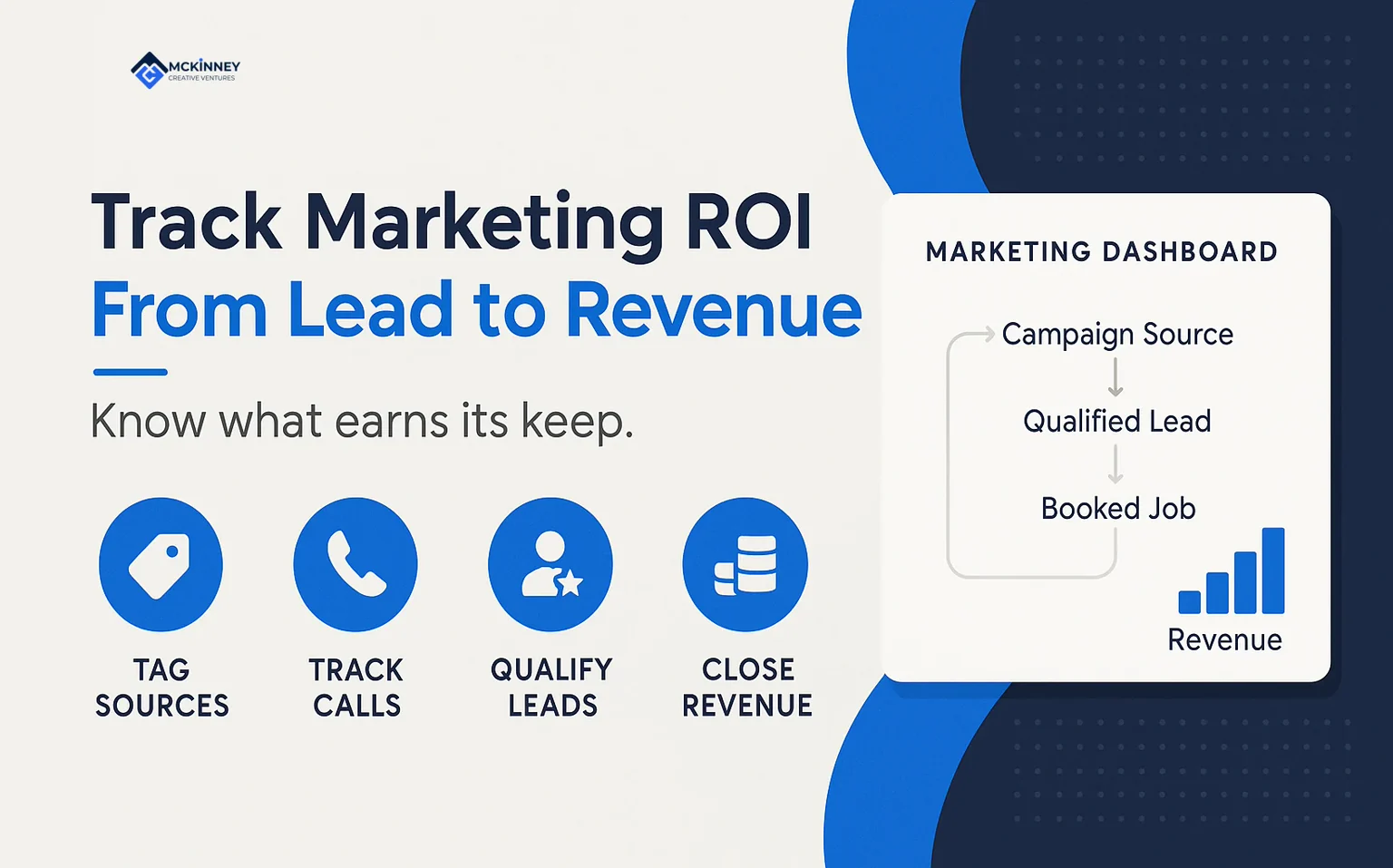
Reporting is the system that tells you which sources produce booked jobs rather than clicks. At minimum it answers four questions every month: how many leads came in by source, how many were answered inside your target, how many became jobs, and what each channel cost per booked job.
The key phrase is booked jobs. Cost per lead is easy to report and easy to misread, because a cheap lead that never answers the phone is more expensive than a costly one that books. Reporting only works if the earlier systems recorded the source at intake and the outcome in the pipeline. We cover the setup in how to track marketing ROI for a service business.
How the Five Marketing Systems Connect
The five are one loop, not five projects. Intake creates the record. Follow-up works the record. The pipeline moves it toward a job. Reviews and referrals start when the job is done and feed new intake. Reporting reads every step and shows where the loop leaks.
Scroll to see all columns
| System | Job it does | What breaks without it |
|---|---|---|
| 1. Lead capture and intake | Brings every call, form, message and ad lead into one record with its source | Leads are scattered across phones and inboxes, and nobody knows where jobs come from |
| 2. Follow-up and nurture | Answers new leads at once and keeps in touch with those not ready to book | Slow or missing replies, and warm leads drift to whoever called back first |
| 3. Sales pipeline and conversion tracking | Shows every opportunity, its stage and the next step | Quotes age unseen, and lost deals teach you nothing |
| 4. Review and referral generation | Asks every finished customer for a review and an introduction | Reviews depend on who remembers to ask, so volume is uneven and the profile gains few new ones |
| 5. Reporting and decision-making | Connects spend and source to booked jobs | Budget decisions rest on opinion, and a weak channel keeps getting funded |
A useful test of any one system is to ask what it hands to the next. If the answer is "a person has to remember," that connection is the next thing to automate. The wider CRM picture, including which tools can carry all five, is in our guide to CRM systems for local service businesses.
The Order to Build Marketing Systems In
Building all five at once is how projects stall. This order follows where money leaks first.
- Intake first. Nothing else works until every lead lands in one place with a source.
- Immediate follow-up second. Missed-call text back and form acknowledgment are small builds with the fastest effect on how many leads you actually reach.
- The pipeline third. Once leads are arriving and being answered, give them stages and next steps.
- Review and referral requests fourth. Trigger them from the won stage so they run on every job.
- Reporting last. It needs clean data from the first four, and it will be accurate only if they ran for a few weeks first.
Local Conditions That Change How You Build Them
Three local facts shape the build for service businesses in our area.
Demand arrives in spikes. Heating, plumbing, roofing and snow work in Minnesota and western Wisconsin follow the weather. The first hard freeze or a hailstorm can produce a week of inquiries followed by a quiet stretch. The systems have to work on the busiest day, when nobody has time to answer, and they should shift to nurture and review requests in the slow weeks, which is when recent work can become next season's referrals.
The map matters. In our experience, many homeowners in the East Metro and the St. Croix Valley find a contractor through map results and call from the listing. That makes the review system and an accurate Google Business Profile part of your marketing infrastructure, not a side task. Calls and messages from the profile have to land in the intake system or the visibility is wasted.
Customers cross the river. A business based in Woodbury or Hudson often serves both Minnesota and Wisconsin, so service areas, tax and licensing details, and the way customers describe where they live all vary within one route. Tag the state or city on every contact so reports can show where the work comes from.
If you want help deciding which of the five is leaking most in your business, contact McKinney Creative Ventures and we will look at it with you.