
Google Business Profile for AI search comes down to one idea: the profile is the part of what Google knows about your business that you can edit directly, so it should be accurate and specific. This post goes with Tech Tips Tuesday episode 7 and is for owners of plumbing, HVAC, photography, marketing and other service businesses in Woodbury, the Twin Cities East Metro and the St. Croix Valley.
Google's Ask Maps announcement says the feature answers complex, real-world questions, and a homeowner might ask, "Who can replace a water heater near Woodbury this week, has strong reviews, and offers upfront pricing?" That example is ours. Google's own examples are everyday errands, and nothing we read says how often trade searches like this one appear in its AI features. This post covers what Google says, what it leaves unsaid, and what to fix.
Google Business Profile for AI search: what Google says
Google announced Ask Maps on March 12, 2026, in a post by Miriam Daniel, VP and GM of Google Maps. The post describes it as a conversational experience that answers complex questions about places and shows results on a customized map. It says that, to build a trip itinerary, Maps analyzes information from "over 300 million places," including reviews from a community of more than 500 million contributors. At the time, it was rolling out in the U.S. and India on Android and iOS, with desktop coming soon.
Google's Ask Maps help page adds two points. Payment from other companies does not influence results in Ask Maps, and paid content in Google Maps is labeled. And AI-powered answers can sometimes be incorrect, which is why Google tells people to check important information in more than one place.
The announcement and the help page do not say how Ask Maps chooses one plumber over another, and they do not name the Business Profile fields it reads. For Search, Google's page on AI features and your website, last updated December 10, 2025 according to the page, lists checking that Business Profile information is up to date among the SEO fundamentals. In practice, that means the profile is the part of what Google knows about you that you can edit directly, and that reviews, which customers write, are part of the picture too. That inference is ours.
A tale of two plumbers
This is an illustrative comparison with no real businesses. The first plumbing company has a profile that says "plumber," a phone number, a few old photos, and reviews that mostly read "great company." The second lists water heater replacement, drain cleaning, water treatment, boiler repair and emergency plumbing. Its photos show technicians doing that work, and its reviews mention specific repairs, response times and the towns it serves. Which profile gives a system more to match against a detailed question?
Google's page on improving your local ranking says local results are mainly based on relevance, distance and popularity. It says complete, detailed business information helps Google understand what a business is and match it to relevant searches, and that no one can request or pay for a better local ranking. You cannot change how close you are to a searcher. In our reading, the second plumber is easier to match, and nothing about that involves keyword stuffing.
Four things to fix this week
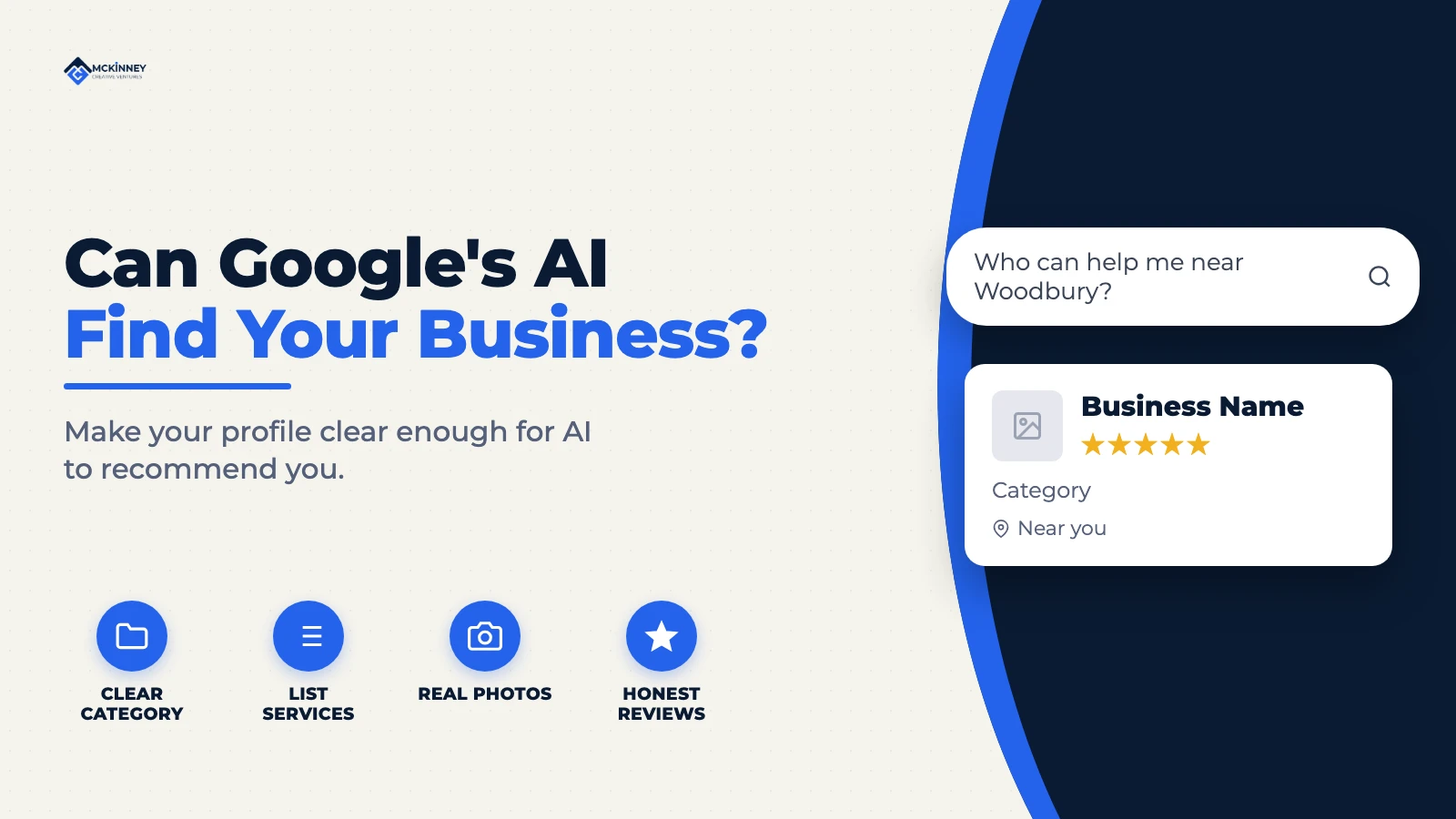
The table lists each fix with what Google's own pages say. Our Google Business Profile optimization guide goes field by field, so this section stays on the four that matter most for AI search.
Scroll to see all columns
| Profile area | What Google's page says | What to do |
|---|---|---|
| Category | Pick a specific primary category, use as few categories as possible, and never use categories only as keywords | Name the core trade first, then add only categories that describe real work |
| Services | Service businesses can add services, with an optional description and price, and custom names should avoid profanity, prices and phone numbers | List each major job the way customers name it |
| Photos | Photos should be in focus, well lit and represent reality, and Google lists work and team among the types to add | Upload recent photos of your own crews and finished jobs |
| Reviews | Ask customers through a Google link or QR code, reply promptly, and never offer incentives | Ask every customer, reply by name and mention the job |
1. Start with your category
Google's page on business categories says to select a primary category that best describes your business and to pick a specific category from the list, with its example being "Nail salon" instead of "Salon." It says you cannot create your own category, that the categories you select affect your local ranking, and that you should not select a category for every product or service. Google's guidelines for representing your business add that you should use as few categories as possible to describe your core business and should not use categories solely as keywords. For a plumbing company, that means the primary category names the trade, and any additional category describes real work the company does.
2. List your services
Do not assume Google knows everything you do. Google's services page says that for categories where it is offered, including service businesses, you can add services, along with a description and a price. It says custom services that violate policy are automatically rejected and advises against profanity, gibberish, personal information, prices or phone numbers in custom service names. It does not give a numeric limit. Use the words a customer would type: "water heater replacement," "sump pump installation," "furnace tune-up."
3. Show the work with real photos
Google's tips for business-specific photos list work and team among the types to add and say photos should be in focus and well lit and should represent reality. The page cautions against significant alterations and excessive use of filters or AI, and says photos do not appear until the business is verified. A photo of your own technician at a Woodbury job site fits Google's call for photos that represent reality.
4. Keep reviews honest and specific
Google's review tips say you can ask customers to visit a Google link or scan a QR code, and recommend replying in a timely way, addressing the reviewer by name and acknowledging their specific feedback. The page calls offering incentives for reviews, including free or discounted goods or services, strictly prohibited. Federal law adds a rule on the same subject. The FTC's 16 CFR section 465.4 bars compensation or incentives conditioned on reviews that express a particular sentiment. Both are general information to confirm with your attorney.
Reviews also show up in AI-generated summaries. BrightLocal's Local Consumer Review Survey 2026 reports that 82% of consumers read AI-generated review summaries. Asked how they use them, 23% chose "I would be happy to read only this information to guide my decision" and 39% would also read a variety of written reviews. BrightLocal says platforms such as Google and Amazon use AI to create snippet summaries above individual reviews. In our view, a plain question such as "What did we fix for you?" invites the specifics a summary can use. Never write a review for a customer.
Service areas when you work on both sides of the St. Croix
Google's service-area page says you can set up to 20 service areas by city, postal code or other area and cannot use a radius. Pick the areas you can staff on both sides of the St. Croix, and see our Woodbury service area page.
Make the website back up the profile
Google's AI features page lists keeping Business Profile information current among the SEO fundamentals, so the website and the profile should say the same things. Our guide to ranking in Google AI Overviews covers the website side, and our SEO, GEO and AEO work includes reviewing Business Profile categories, services, hours, contact details and service areas against what the business offers, and keeping that information consistent across the places customers use to evaluate it.
Your action step for today
Open your Google Business Profile as though you know nothing about your company. Could someone tell in ten seconds what you do, where you work and why to choose you? Then read the category, the services list and the last ten reviews as a system would, one line at a time. Fix the first gap you find, and write down the date. We cannot promise that a change will move you in Ask Maps or any other AI feature, because Google has not published how those features choose businesses, but an accurate profile is the thing you control. If you want a second opinion on yours, contact us.