
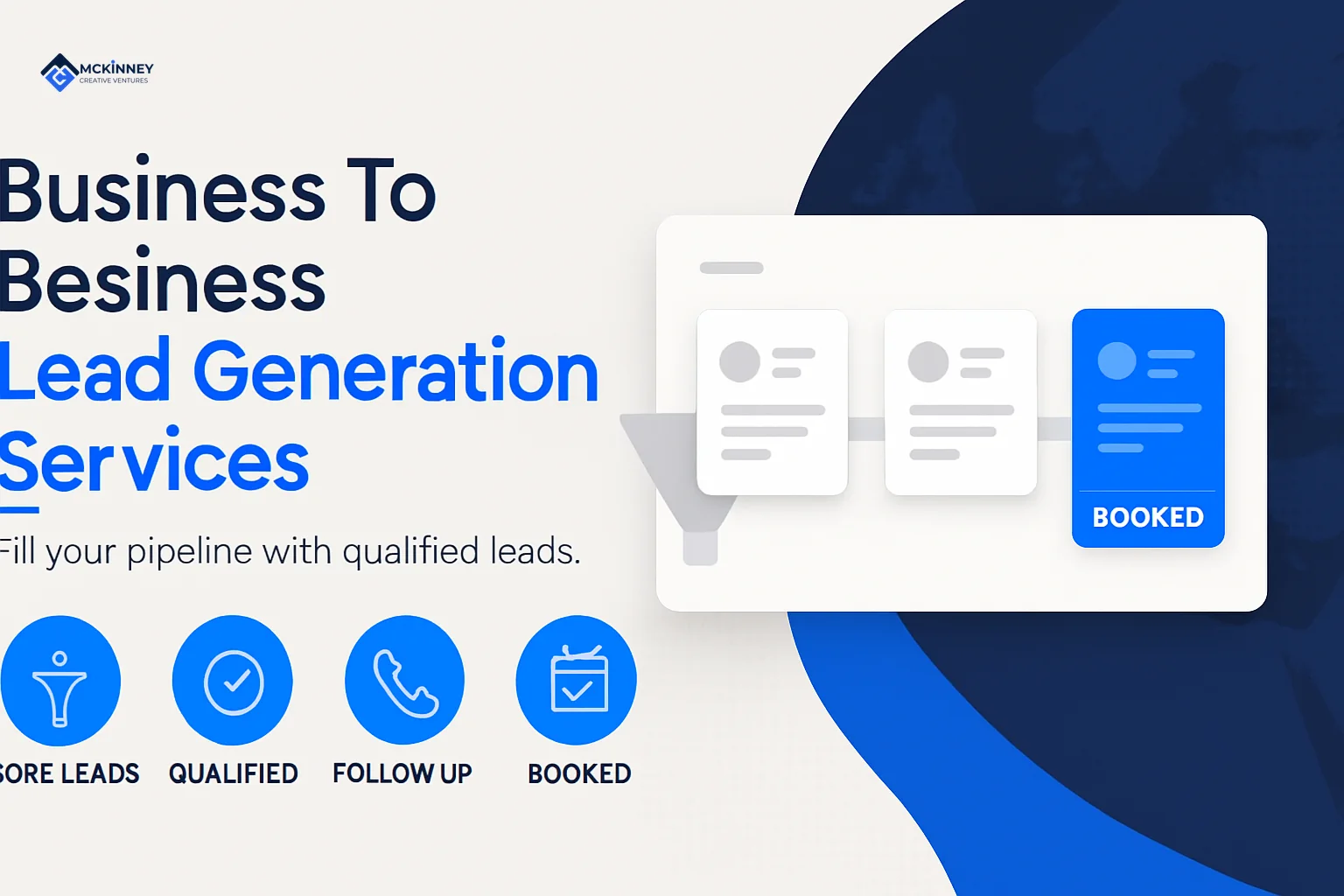
Business to business lead generation services are the outside providers and tools a company pays to find and win other companies as customers. This guide is for owners of Twin Cities East Metro, St. Croix Valley and western Wisconsin firms that sell to other businesses, such as a commercial contractor serving property managers, a professional services firm or a commercial cleaning company. It explains what each type of service does, which rules apply to the outbound ones, and how to choose a provider and judge the work.
Some of this list is work we do and some is not. McKinney Creative Ventures builds websites, does SEO, GEO and AEO, runs Google Search advertising and builds CRM and automation. We do not offer telemarketing, cold calling, outbound appointment setting, SDR services, or buying lists or leads, and a later section says so plainly. This is general information and not legal advice, so confirm any rule with your attorney.
Business to business lead generation services: what each type does
Providers use the same label for very different products. The table sets each type beside the question that matters most for it.
Scroll to see all columns
| Type of service | What you are buying | What to check first | Do we offer it? |
|---|---|---|---|
| Inbound content and SEO | Pages and posts that a buyer finds when they search | Whether the content answers real buyer questions and how results are measured | Yes, as website and SEO, GEO and AEO work |
| Paid search | Ads that appear when a buyer searches a term you choose | What a click costs and whether leads are tracked to closed deals | Yes, Google Search advertising |
| LinkedIn advertising | Ads aimed by job title, industry and similar attributes | Whether the audience is large enough in your region | No, it is not on our advertising list |
| Outbound calling | A team that phones businesses you have not spoken to | The call rules, the script and the list source | No |
| Outbound email | Commercial email to prospects | CAN-SPAM requirements and who sends it | No |
| Appointment setting | Booked meetings, usually from calls or email | How a billable appointment is defined | No, outbound appointment setting is outside our work |
| List and data vendors | Contact records you did not collect yourself | Where the data came from and who owns it | No |
Inbound: content, SEO and paid search
Inbound services work on the buyer who is already looking. A facilities manager searching for a vendor, or a property manager asking an AI tool who handles snow removal for commercial lots, is the reader an inbound page serves. Our SEO, GEO and AEO service covers useful service content, accurate local information and clear measurement across Google Search, Maps and AI answers, and it does not promise a ranking.
Paid search puts an ad in front of that same searcher. Google's Google Ads help page on the benefits of advertising says there is no minimum and that you only pay when someone clicks your ad. For a business buyer, a click is the start of a long process, so the useful measure is what happens after it. Our digital advertising service tracks campaigns from click to booked job.
LinkedIn's own advertising page says you can target an audience by job title, industry, skills and more, and that you control the daily or lifetime budget and can start, stop or change ads at any time. That targeting suits a seller who knows the job title of the buyer. The question for a regional firm is whether enough of those people in the Twin Cities and western Wisconsin use the platform to justify a budget, and a test with a small, tracked spend answers it better than a vendor's claim. We do not run LinkedIn campaigns for clients, and we have no data of our own on how it performs for regional B2B firms.
Outbound: calling, email and appointment setting
Outbound services start with a list and a message and reach people who have not asked to hear from you. They can scale quickly, and the rules in the next section apply to them. Appointment setting is usually a layer on top, where the provider books a meeting from a call or email and bills per meeting. Our guide to B2B telemarketing services, linked in the next section, goes into the call side, including what call reporting to ask for.
Lists and data vendors
A list vendor sells records of businesses and people. The first question is where the records came from. A phone number on a business list may belong to a person, and an email address carries its own rules, so a vendor that cannot explain its sources is a risk you carry as the seller.
What the rules say about outbound calls and email
These summaries paraphrase the sources and are current as of November 2026. A short guide cannot settle every case, so ask your attorney about your own program.
Telemarketing Sales Rule and business calls
The FTC's Telemarketing Sales Rule exempts calls between a telemarketer and a business to induce a purchase, with limits. The exemption in 16 CFR 310.6(b)(7) does not reach the rule's misrepresentation bans in 310.3(a)(2) and (4), and it does not reach calls to induce the retail sale of nondurable office or cleaning supplies. The bans on misrepresentation in business calls came from the FTC's April 2024 final rule, published at 89 FR 26760. In our reading, a cleaning firm that sells a service and a distributor that sells supplies may sit on different sides of the supplies line, so ask your attorney which describes you. Our B2B telemarketing guide covers the rule text, the Do Not Call Registry, texting and the Minnesota and Wisconsin rules in more detail.
The FTC's CAN-SPAM compliance guide says the law covers all commercial messages and makes no exception for business to business email. It lists the main requirements: accurate header information, a subject line that matches the content, a clear disclosure that the message is an ad, a valid physical postal address, and a clear way to opt out. It says opt-out requests must be honored within 10 business days, and that you cannot sell or transfer the addresses of people who opted out, except to a company you hired to help you comply. The guide also says that hiring another company to handle your email marketing does not let you contract away your legal responsibility, and that both the company whose product is promoted and the company that sends the message may be held responsible.
The FTC says that about email, and calls and texts have their own rules that a short guide cannot settle. In our reading, a vendor's contract can divide the work, and we would not assume it moves your responsibility as the seller to someone else. Ask your attorney how that applies to each channel. Ask the provider in writing who writes the message, who sends it, who handles opt-outs and who keeps the records.
How a Twin Cities firm chooses among them
The right mix depends on how many buyers you have, how long a sale takes and how a buyer looks for a vendor. These three examples are illustrative, and the reasoning is ours.
- A commercial contractor serving property managers. The buyers are a limited group of managers and owners across the East Metro, and in our experience a vendor change often follows a contract renewal or a job that went wrong. In our reading, inbound pages that show past commercial work, and a clean response when a manager calls, matter more here than a call campaign. A short, hand-built list of target accounts can be worked by the owner.
- A professional services firm. The buyer often asks a colleague or searches by service and city before contacting anyone. In our reading, content that explains the work, with named authors, and a Google Business Profile that matches the website are the places to start. LinkedIn is worth a small test if the firm knows the buyer's job title.
- A commercial cleaning company. In our experience the buyer is often a facilities manager or an office manager choosing a vendor on price, reliability and references. In our reading, paid search for the services and areas covered, plus a quick response to every inquiry, fits that purchase. Whether the company sells services only or supplies as well is a question for your attorney because of the call rule above.
In all three cases, in our experience, the weak point is usually the follow-up. A commercial inquiry that waits a day for a reply was paid for already. Our CRM and automation service builds on GoHighLevel and covers speed to lead, pipelines and booking, so each inquiry can be logged with its source and followed up quickly.
How to judge a provider
Whatever you buy, a few questions separate a provider you can manage from one you cannot.
- How does it define a lead? A form fill, a conversation and a booked meeting are different things at different prices.
- Who owns the data, the accounts and the content if you leave?
- Can you see what is sent in your name before it goes out, whether that is a call script, an email or an ad?
- Where did the list come from, and what does the provider do when a number or an address should not be contacted?
- How does it report? Look for sources tracked to meetings held, quotes sent and jobs won in your own CRM, because a count of leads alone tells you little.
- What is the term, and what happens at the end of it?
Give any new channel a defined test, such as a set budget over a set number of weeks, and compare the cost per meeting held with what you already spend. Ask the provider for references from firms of your size in your trade, and call them.
What we do and do not offer
To be plain about the list above, we do not make outbound sales calls, send cold email campaigns, book meetings from outbound calls, supply SDRs, or buy or sell lists and leads. If you want one of those, buy it from a provider that does it, and use the questions above. We build the pieces that catch and follow up a buyer who comes to you, such as the website, search work, Google Search ads and the CRM behind them. If you want help choosing which inbound pieces to build first, contact McKinney Creative Ventures.