
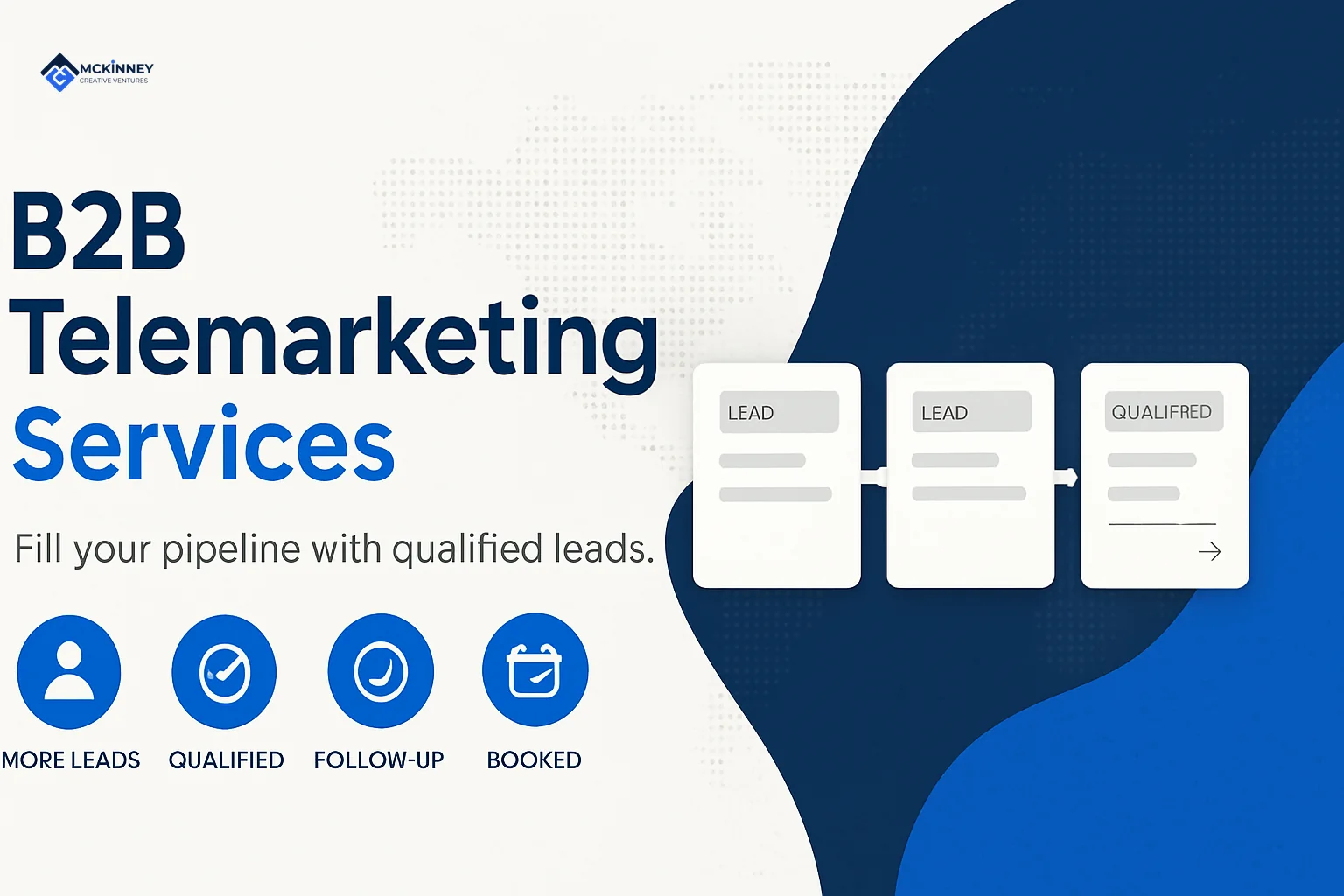
B2B telemarketing services are phone-based outreach programs that build lists of businesses, call decision-makers, qualify interest and book appointments for a sales team. A company can run the program with its own sales development reps or hire an outsourced B2B call center. This guide is for East Metro, St. Croix Valley and western Wisconsin companies that sell to other businesses, such as commercial trades and service firms whose buyers are property managers, facilities managers and general contractors.
It explains what the services include, how an in-house rep compares with an outsourced call center, what call reporting to ask for, and which rules to check before anyone dials. It is general information, not legal advice. McKinney Creative Ventures does not make outbound sales calls. Our related work is the CRM and automation that catches and follows up inbound business leads.
What B2B Telemarketing Services Include
Providers package the work differently, but the pieces are consistent.
- List building. Finding the businesses and the roles to call, such as the facilities manager at a multi-building property. Ask where the list comes from, because the source affects both quality and legal risk.
- Cold calling. Reaching people who have not asked to hear from you. In our experience, much of the call time goes to voicemail, gatekeepers and polite refusals.
- Qualification. A short set of questions that confirms the company is in your service area, buys what you sell and has a decision-maker or a path to one.
- Appointment setting. Booking a meeting, site walk or estimate with your sales team. Our post on lead generation appointment setting covers how to define a billable appointment.
- Follow-up on inbound leads. Calling back a business that filled in a form or phoned you. This is a different job from cold outreach, and it is usually faster and cheaper to handle with your own CRM.
The same vendor may offer all five or only one. Ask which of them you are paying for, because cold calling and inbound follow-up have different costs and different rules.
In-House Sales Rep or B2B Call Center?
A B2B call center is an outsourced team that makes the calls under a contract, sometimes called a B2B call centre in other markets. An in-house rep works only for you. The table compares them without prices, because costs vary by provider and scope.
Scroll to see all columns
| Factor | In-house sales development rep | Outsourced B2B call center |
|---|---|---|
| Knowledge of your trade | Builds over time and can ride along on jobs | Depends on the script and briefing; often shared across clients |
| Speed to start | Slower, because of hiring and training | Faster to begin once the contract and script are agreed |
| Capacity | Fixed by headcount | Can scale up or down by contract terms |
| Control of messaging | High, with direct coaching | Set by the script and the review process you agree |
| Control of data and records | Everything sits in your CRM | Depends on the contract, so ask who holds lists, recordings and consent records |
| Legal responsibility | Yours | Yours as the seller, and a provider can have its own duties; the contract should say who does what |
In our experience, a small commercial contractor with one salesperson tends to get more from a part-time in-house rep and a tracked CRM than from a large outsourced campaign that no one on the team has time to coach. That is our judgment, not a measured result.
What Call Reporting to Ask a B2B Telemarketing Provider For
Some buyers search for which B2B telemarketing providers share call insights to improve sales messaging. We have not ranked vendors and will not name one. Here are questions to put to any provider instead. Their answers show whether the reporting would teach you anything.
- Call recordings. Can you listen to a sample each week? Recording consent rules vary by state, so ask your attorney how recording applies to calls made in Minnesota, Wisconsin or elsewhere before you rely on it.
- Disposition codes. Does every call end in a coded outcome, such as no answer, gatekeeper block, not interested, call back or booked, so you can count each?
- Objections heard. Are the objections recorded in the notes, and does someone summarize them for you monthly? That summary is the real call insight. It tells you whether the problem is the offer, the list or the script.
- Lead handoff. How does a booked appointment reach your CRM, how fast, and with what notes?
- Records. What records does the provider keep, for how long, and can you export them?
Judge the program by what happens after the appointment. Track meetings held, quotes sent and jobs won by source, a method you can set up in a CRM.
B2B Telemarketing Rules to Check Before Anyone Dials
This section summarizes what each source says, current as of November 2026. It is general information, not legal advice, and a short summary cannot cover every case. Confirm your own plan with your attorney. Every rule below has its own conditions, and they do not merge into one test.
The Telemarketing Sales Rule and business calls
The Federal Trade Commission's guide to the Telemarketing Sales Rule says "most phone calls between a telemarketer and a business are exempt." It then lists exceptions. Calls to a business line that solicit individual employees to buy for their own use are also not business-to-business calls under the guide.
The rule text matters too. Under the current text of 16 CFR 310.6(b)(7), calls between a telemarketer and a business to induce a purchase are exempt, but the exemption does not apply to the requirements of 310.3(a)(2) and (4). Those sections cover misrepresenting material information in the sale of goods or services and making a false or misleading statement to induce payment. The rule text also keeps calls to induce the retail sale of nondurable office or cleaning supplies outside the exemption. The business-call coverage of the misrepresentation provisions was added in the FTC's April 2024 amendments (89 FR 26760), and the FTC guide's text does not mention it. An exemption narrows which provisions apply to a call. It does not approve a calling program, so a B2B campaign still needs a script that is accurate about price, terms and results.
The Do Not Call Registry and mixed numbers
The FTC's Registry FAQs say the Registry is for personal phone numbers and that business phone numbers and fax lines are not covered. B2B lists, however, often include direct dials and mobile numbers. Our concern is that a number on a business list may be an individual's personal number, such as a sole proprietor's mobile. The FTC page does not say how to treat that case, so ask your attorney how your list vendor screens numbers and what it does when a number may be personal.
Texts, autodialed calls and prerecorded calls
The FCC's consumer guide on robocalls and texts was last updated in February 2026. It says FCC rules require prior written consent before a prerecorded telemarketing call to a home or wireless number, and require oral or written consent before an autodialed or prerecorded call or text to a wireless number. It also says commercial texts require written consent. The guide is written for consumers and does not address business-to-business calls, so ask your attorney whether these rules reach a given business contact's mobile number.
Wisconsin and Minnesota
The Wisconsin Department of Agriculture, Trade and Consumer Protection says on its telemarketer registration page that registration applies to companies that call or text residential customers or individuals' personal numbers with unrequested sales messages. That page does not address business-to-business calls. Minnesota's chapter 325E defines a commercial telephone solicitation as an unsolicited call to a residential subscriber. The same chapter bars automatic dialing-announcing devices unless the subscriber has consented, with listed exceptions, and sets a 9 a.m. to 9 p.m. window for those devices and commercial telephone solicitations. Whether either state's rule touches a particular B2B call is a question for your attorney. Our appointment setting guide linked above summarizes the consumer-side rules in more detail.
Two practical points follow. First, assume nobody on the vendor's side has reviewed your list for you, and ask. Second, the seller is still the seller. The FTC guide says any businesses or individuals that take part in telemarketing must comply, with some exceptions, and its Registry section says it is against the law to call, or cause a telemarketer to call, a number on the Registry unless an exception applies.
Does B2B Telemarketing Still Work?
Buyers sometimes ask whether telemarketing still works for technology-sector outreach. We have no reliable public data that answers that, and this post does not cover the technology sector. For a local trade or service firm, the test is local and measurable: run a defined number of calls to a defined list, count meetings held and jobs won, and compare the cost to your other channels.
The sales cycle in commercial work also matters. A property manager may not need a new vendor until a contract renews or a job fails, so in our experience a cold call often finds the buyer at the wrong time.
Where Inbound Follow-Up Fits
Before paying anyone to dial strangers, check how your own inbound business leads are handled. A commercial inquiry that waits a day for a reply is a lead you already paid for, and fixing that costs less than finding a new one. Our post on lead generation and telemarketing for local service businesses covers the consumer side of phone outreach, and our construction and trades page describes the kinds of businesses we work with. For commercial buyers, the same CRM approach applies: log every inquiry with its source, reply fast and keep a pipeline that shows what is open.
If you want your inbound business leads captured and followed up automatically, contact McKinney Creative Ventures.