
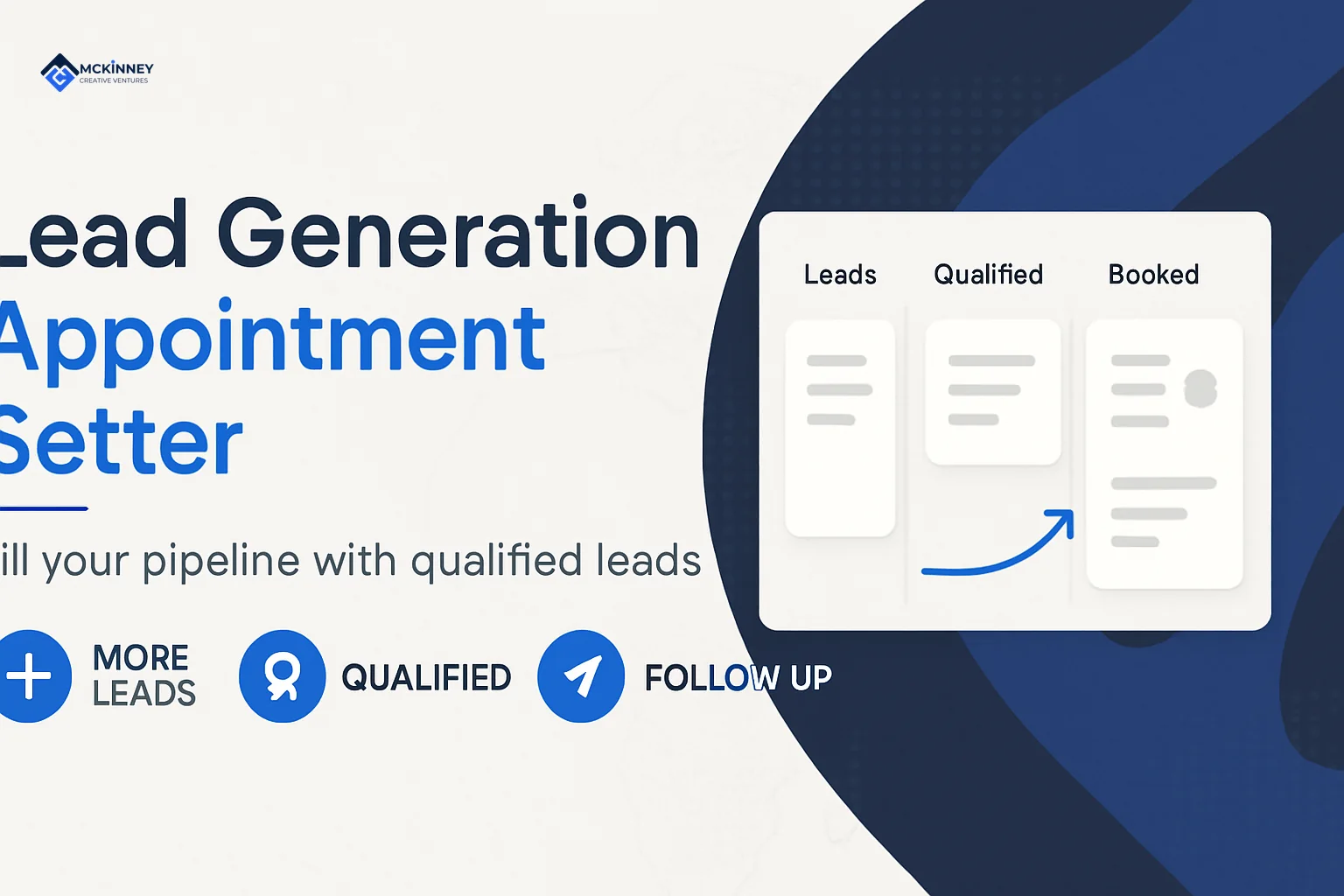
Lead generation appointment setting is the work of turning people who have shown interest into confirmed appointments on your calendar. For a local service business in the Twin Cities East Metro, the St. Croix Valley or western Wisconsin, that appointment is usually an estimate, a site visit or a service call, and you have four ways to staff it: an in-house setter, an outsourced setter, a pay-per-appointment vendor, or automated booking from your CRM.
This post is for owners deciding who should answer, qualify and book the leads their marketing produces. It explains what a setter does, how the options compare, how follow-up works, and the outbound calling rules to check before anyone dials a stranger. The calling rules are general information, not legal advice.
What an Appointment Setter Does
An appointment setter is the person who contacts a lead, confirms there is a real need, and books a time for the people who will do the work or the selling. The role is also called a lead setter or, in sales teams, a setter, as opposed to a closer. The setter does not sell the job. The setter gets the right customer onto the calendar with the right information.
In sales language, the answer to "what is a setter" is simple: the setter sets the meeting and the closer runs it. For a plumbing, HVAC or roofing company, the closer might be the estimator who visits the home. In many small shops the office manager is the setter, and the owner is the closer.
A good setter does four things. They reach the lead quickly. They ask a short set of qualifying questions, such as the address, the problem, the timing and whether the customer owns the property. They book a specific time and confirm it. And they record everything in the CRM so the person who shows up is not starting from zero.
How Lead Generation and Appointment Setting Fit Together
Lead generation creates the interest. Appointment setting converts it into a booked event. They are separate jobs with separate measures. Lead generation is judged by lead volume and cost per lead. Appointment setting is judged by the share of leads that reach a booked appointment and by how many of those appointments the customer attends.
Keeping the two apart helps when results slip. If you get plenty of leads and few appointments, the problem is in setting: slow response, poor questions or no follow-up. If you get few leads, the problem is upstream in your ads, search visibility or website. In our experience, owners who blend the two tend to buy more traffic when the real issue is that existing leads are not being reached.
Speed is the clearest example. A Harvard Business Review audit published in 2011 of 2,241 U.S. companies found that 23% never responded to a web-generated test lead, and that the average response time among those that responded within 30 days was 42 hours. A setter, human or automated, exists to close that gap, and our post on speed to lead for service businesses goes deeper on it.
Lead Generation Appointment Setting for a Local Service Business
Much appointment-setting content online is written for business-to-business sales teams booking demos with decision-makers on LinkedIn. A local service business has a different problem. Your leads are homeowners and property managers who called, filled in a form, messaged your Google Business Profile or responded to an ad. They have already asked for help. Setting the appointment is mostly about speed, clarity and removing friction.
A booked estimate in this setting needs a handful of facts: the address, the service, a rough description, a preferred window and a mobile number that accepts texts. It also needs a confirmation and a reminder, because a missed appointment costs a truck roll. A Minnesota winter adds a seasonal wrinkle. When the first hard freeze or a heavy snow brings a wave of inquiries, the same office that books the work is also busy doing it, so the booking process cannot depend on one person being free.
For that reason, the best answer for many East Metro and St. Croix Valley service companies is not choosing between a person and software. It is deciding which leads go to which.
In-House, Outsourced, Pay-Per-Appointment or Automated: Comparing Your Options
Each model has a different cost structure and a different failure mode. The table compares them without prices, because costs vary widely and any number we quoted would be a guess.
Scroll to see all columns
| Option | How it works | Strength | Main risk |
|---|---|---|---|
| In-house setter | An employee or office manager calls, texts and books leads | Knows your services, area and voice; accountable to you | Wage and training cost; coverage gaps during lunch, sick days and busy weeks |
| Outsourced setter | A call center or virtual assistant handles calls and booking on your behalf | Extended hours without hiring; scalable in busy seasons | Lower knowledge of your trade and area; variable quality of qualification |
| Pay-per-appointment vendor | A vendor generates leads and books appointments, and you pay per appointment | You pay for an outcome instead of effort | Definition of a qualified appointment can be loose; outbound methods carry calling-rule risk |
| Automated booking from the CRM | Instant text, email and a booking link fire from the lead event itself | Responds in seconds at any hour; consistent every time | Cannot handle unusual jobs or a nervous customer without a human handoff |
For inbound leads, in our experience the best starting point is the automated option, because it covers the first response at any hour, then adding a person for the calls that need judgment. A missed-call text back is the simplest example: the system acknowledges the call at once and a person finishes the booking. Our CRM and automation work is built on GoHighLevel and includes booking and speed to lead as core pieces.
When you evaluate a pay-per-appointment vendor, ask three things in writing. What counts as an appointment, and does the customer have to attend? Where do the leads come from, and did the people consent to be contacted? Does the vendor make outbound calls to Wisconsin or Minnesota residents on your behalf, and are they registered where required? The last two questions connect to the calling rules below.
Can Appointment Setters Follow Up With Prospects?
Yes, and persistence is a large part of the job. Following up is the setter's main task when a lead does not answer the first time. A sensible pattern for a service lead is an immediate text, a call within minutes, a second attempt later the same day, a short message the next day and then a slower sequence. Stop when the customer books, says no or asks to be left alone.
What matters is how the contact started. A person who just filled in your form or called your office asked to hear from you, so replying quickly is the expected case. Texts and automated messages still need consent, and the federal inquiry window for calls is three months (see the rules below). Our post on lead follow-up automation describes how to build the sequence. A cold list of strangers is a different matter and is covered by the calling rules in the next section.
Record every attempt in the CRM. A written log helps you answer if a customer later says they were contacted after asking to stop, and it shows which attempt number produces bookings.
Outbound Calling Rules to Check Before Anyone Dials
The rules below apply to outbound sales calls, so they matter if a setter or vendor will call people who did not contact you first. This is a summary of what each source says, current as of November 2026. It is general information, not legal advice. Confirm your own practice with your attorney.
Federal rules: the Telemarketing Sales Rule and the Do Not Call Registry
The Federal Trade Commission's guide to the Telemarketing Sales Rule says any businesses or individuals that take part in telemarketing must comply with it, with some exceptions. On the Registry, it says sellers must synchronize their lists with an updated version of the National Registry every 31 days, and that calls are restricted outside the hours of 8 a.m. and 9 p.m. local time at the location called. It says the Registry prohibition does not apply to business-to-business calls. Other parts of the rule and state laws can still apply.
The guide also describes an established business relationship exception: a transaction within the 18 months preceding a call, or three months from the date a consumer makes an inquiry or application, provided the consumer has not asked to be on the seller's own Do Not Call list. Prerecorded sales calls require the recipient's prior signed, written agreement.
Wisconsin
The Wisconsin Department of Agriculture, Trade and Consumer Protection says on its telemarketer registration page that companies making unrequested calls or texts to Wisconsin residents' personal phone numbers to encourage a purchase must register with the department and also with the FTC. It states that calls to numbers on Wisconsin's registry are allowed only if the consumer affirmatively requested the call in writing, is a former client checking whether a contract lapsed by mistake, or is a current client. It adds that a purchase in the past 18 months does not make someone a current client under Wisconsin law, even though it can satisfy the federal exception. The federal exception and the Wisconsin rule are therefore not the same, which matters for a Minnesota business calling across the St. Croix.
Minnesota
Minnesota's statutes on automatic dialing-announcing devices define a commercial telephone solicitation as an unsolicited call to a residential subscriber with no prior business or personal relationship, made to solicit the purchase of goods or services. Section 325E.30 says a caller shall not make one before 9:00 a.m. or after 9:00 p.m. Section 325E.27 bars devices that dial numbers and play a prerecorded or synthesized voice message unless the subscriber has consented or a live operator first obtains consent. The attorney general can seek a civil penalty up to $50,000 for violations of those sections. Section 325E.31 also provides a private right of action for damages. The same chapter shows sections 325E.311 to 325E.316 as expired in 2009. We have not researched other Minnesota rules, which is one more reason to ask your attorney.
The FTC page notes that the FCC separately regulates telemarketing under the Telephone Consumer Protection Act. We have not summarized those rules here, and your attorney should. Before you run any outbound calling or texting program, ask your attorney to review the lists, scripts and vendor contract. Calls and texts to people who contacted you are treated differently from cold outreach, but the federal inquiry window is three months and texting has its own consent rules. Have your attorney review your follow-up sequence as well as any cold calling. To plan the inbound booking flow, contact McKinney Creative Ventures.