
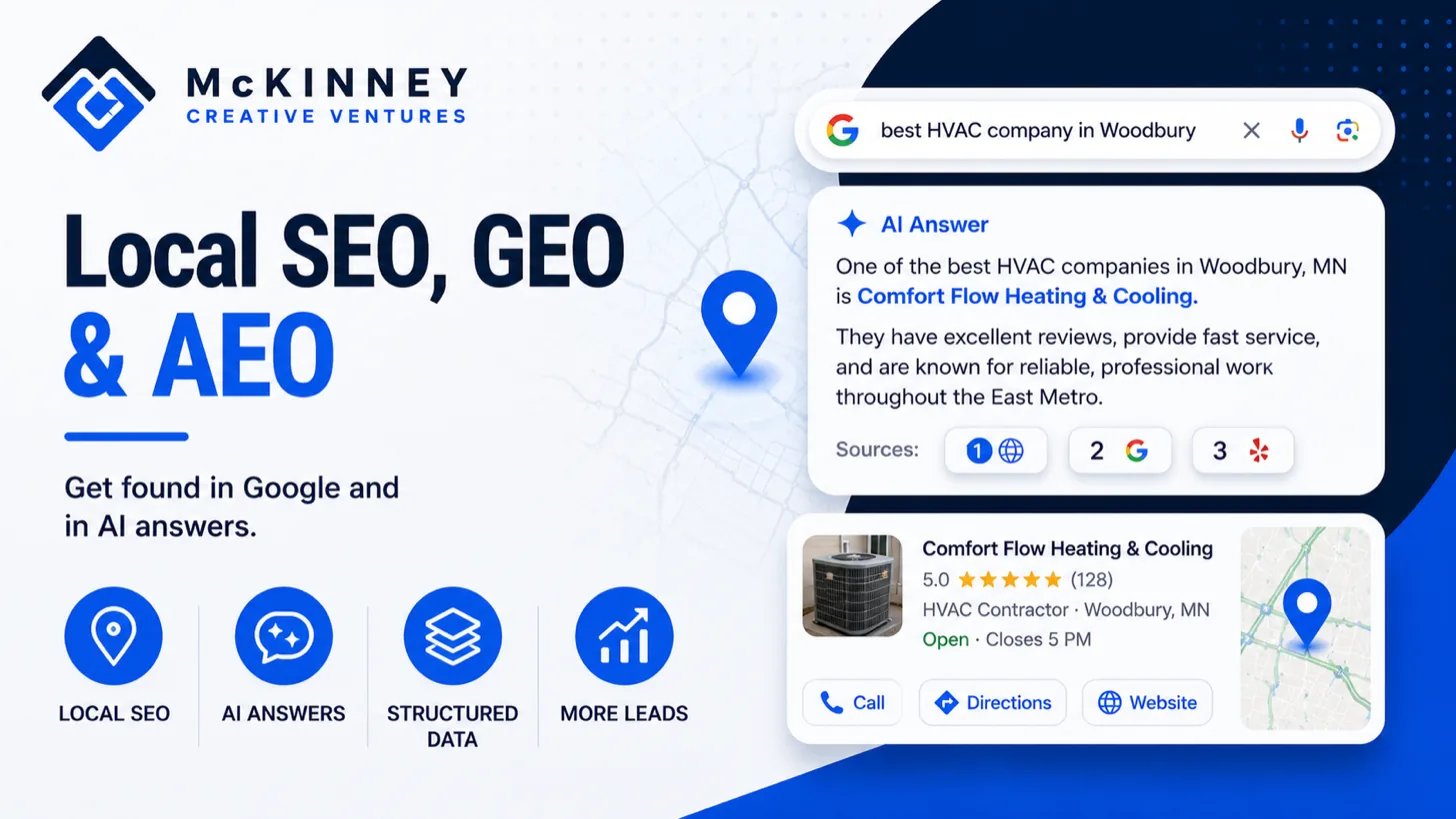
Twin Cities SEO for a service business in 2026 has three layers: local SEO for Google's results and map pack, generative engine optimization (GEO) for AI models like ChatGPT and Perplexity, and answer engine optimization (AEO) for featured snippets, voice search and AI Overviews. You build them in that order, on one set of facts about who you are, what you do and where you do it.
This guide is for owners of plumbing, HVAC, roofing, electrical, landscaping and similar businesses in the Twin Cities East Metro, the St. Croix Valley and western Wisconsin. It explains what each layer does, what to do first, and which popular tactics deserve less of your time. Where Google has published guidance we link it. Where a tactic is only a common belief, we say so.
What Is Local SEO in 2026
Local SEO is the work of appearing in local search results and the Google map pack when someone nearby searches for a service. Google says local results are mainly based on relevance, distance, and popularity, and that complete, detailed business info helps Google match a profile to relevant searches (Google Business Profile Help). Google also states there is no way to pay for a better local ranking.
That puts the weight on three things you control: a profile that matches what customers search for, a service area your website clearly supports, and a reputation that proves you are a real, active business. Keyword stuffing does not help with any of them.
What Is Generative Engine Optimization (GEO)
Generative Engine Optimization (GEO) is how you make your business easy for AI models like ChatGPT, Perplexity, Claude and Gemini to describe accurately. These tools assemble answers from sources they can read and trust. A site full of vague claims gives them nothing to quote. A site with specific facts about your trade, your location and your service area gives them clear statements to repeat.
What Is Answer Engine Optimization (AEO)
Answer Engine Optimization (AEO) is the practice of structuring content so it can be lifted out as a direct answer for featured snippets, voice search and AI Overviews. When a homeowner in Woodbury asks a phone, "Who is the best emergency plumber near me?", AEO is part of what decides whether your business is named. The other part is local SEO: a voice assistant still needs a trusted local business to recommend.
Twin Cities SEO, GEO, and AEO: How the Three Layers Work Together
These are not three separate strategies. They are layers of one system. Traditional SEO builds relevance and authority. GEO makes sure AI models understand what you do and where you do it. AEO formats that understanding so it can be delivered instantly in zero-click searches.
Scroll to see all columns
| Discipline | Optimizes for | Where it shows up | Core levers |
|---|---|---|---|
| SEO, Search Engine Optimization | Ranking links in classic search | Google and Bing results pages | On-page relevance, site authority, technical health, local signals |
| GEO, Generative Engine Optimization | Being understood and cited by AI models | ChatGPT, Perplexity, Claude, Gemini, Google AI Overviews | Entity clarity, structured data, reputation and citations across the web |
| AEO, Answer Engine Optimization | Being the direct, quotable answer | Featured snippets, voice assistants, zero-click answers | Question-based headings, concise first-sentence answers, tables and lists |
The practical takeaway: you do not pick one. Build the SEO foundation, state your facts so AI engines can read them (GEO), then format the answers so they can be lifted directly (AEO). Google says the best practices for SEO remain relevant for its AI features, so the first layer is never wasted (Google Search Central).
How to Do Local SEO for a Twin Cities Service Business
Google Business Profile
Your Google Business Profile is your most valuable local asset. Verify it, fill in every category, service and attribute, and keep the hours and service area current. Upload real photos of your own crew at real jobs.
NAP Consistency
Your name, address and phone number (NAP) should read identically on your website, your profile, your social accounts and the directories that list you. Small variations make it harder for Google to confirm they are the same business.
Local Citations and Directories
List the business in the directories that matter in your trade and area, such as your local chamber of commerce and the industry sites homeowners use. A few accurate listings beat a hundred copied ones.
Service Area Pages
Build a dedicated page for each city you want to win, such as Stillwater, Hudson or River Falls. Do not just swap the city name. Each page needs real local context, the work you do there and the questions customers there ask. Our Twin Cities service area page shows the standard we hold ourselves to.
Reviews
Google says more reviews and positive ratings can help local ranking, so keep genuine reviews coming. Ask every customer, never offer anything in exchange, and never script the wording. The rules are stricter than most owners assume, so read our guide to Google's review policies before you set up a request process.
Local Backlinks
Earn links from organizations that know you: suppliers, sponsored teams, community groups, local news and neighboring trades.
How to Do GEO for a Local Business
Entity-First Writing
Write clear statements a model can quote without guessing. Instead of "We are the premier choice for your home needs," write "We are a licensed HVAC contractor based in Woodbury, MN, serving the East Metro."
Author and Business Credentials
Connect your content to real people with real credentials. Name the owner or technician who wrote or reviewed a page, list licenses you actually hold, and link to profiles that confirm them. This supports the experience and trust signals Google describes as E-E-A-T.
llms.txt and AI-Specific Files
An llms.txt file is a plain-text summary of your business facts placed at the root of your domain. It costs little to publish, but treat it as optional. Google's AI features documentation says site owners do not need to create AI-specific files or markup to appear in AI Overviews or AI Mode (Google Search Central). Your visible pages carry far more weight than any hidden file.
Factual Density
Replace adjectives with facts you can stand behind: years in business, the services you offer, your license numbers, your real service radius, and how your pricing works.
How to Do AEO for a Local Business
Question-Based Headings
Write headings in the exact words customers use, such as "How much does a new roof cost in Minnesota?" or "Do I need a permit to replace a furnace?"
Direct Answers First
Directly under each question heading, give a one or two sentence answer. Then expand with detail, steps and exceptions. A model, a snippet and a rushed homeowner all want the answer first.
FAQ Sections
Keep a short FAQ at the bottom of important pages, with real questions and plain answers. Be careful about what markup promises. Google's documentation says the FAQ rich result no longer appears in Google Search starting May 7, 2026 (Google Search Central). The visible questions still help readers and answer engines, but do not add FAQ markup in hope of a special display.
Step-by-Step Content
For any process, such as shutting off a main water valve or preparing for a furnace tune-up, use a numbered list with one action per step.
AEO for Cities and Municipalities
Some readers arrive here looking for AEO for a city or village website. This guide is written for service businesses, and public agencies have extra requirements, such as accessibility and records rules, that we do not cover. The page pattern still carries over. Put the answer to a resident's question, such as permit steps, office hours or who to call, in the first lines under a question heading. Publish it as plain page text instead of a PDF, and keep the facts identical across the website and the public Google profile.
Structured Data for Twin Cities Service Businesses
Structured data labels the facts on a page so machines do not have to infer them. Google says it uses structured data to understand the content of a page and that JSON-LD is, in most cases, the easiest format to implement and maintain (Google Search Central, structured data introduction). Its structured data policies add that Google does not guarantee structured data will show up in search results, even when the markup is correct. For a local business the useful type is LocalBusiness on schema.org, which includes an areaServed property for the geography you cover.
Google's own local business guide lists the business name and address as required, with hours, phone number, URL and location coordinates as recommended (Google Search Central, local business structured data). Whatever you mark up must match what visitors can see on the page and what your Google Business Profile says. Markup that contradicts the page can do more harm than none. Schema supports your content. It does not replace it.
How to Choose a Twin Cities SEO, GEO, or AEO Provider
If you are comparing agencies in Minneapolis, St. Paul or the East Metro, judge them on what they will do rather than the acronyms they use. We are McKinney Creative Ventures, a Woodbury agency that sells this work, so weigh our view with that in mind. These questions apply to any provider, including us:
- What will you actually change? A good answer names pages, profile fields and fixes, not a vague promise of visibility.
- How do you handle structured data? It should match your visible content and be checked with Google's testing tools.
- Who writes the content? Generic copy swapped between cities fails the standards above.
- How will you report? Look for calls, form leads and non-brand search clicks, not rankings alone.
- What do you refuse to promise? Nobody can guarantee a position or a citation in an AI answer.
Our SEO, GEO, and AEO service covers all three layers as one connected system, and the same questions are fair to ask us.
Common Mistakes Twin Cities Businesses Make
The most common mistake is repeating a city name across a page or footer in the hope that it ranks. Another is ignoring the Google Business Profile after setup. A third is never checking how AI tools describe the business, so errors about services or service area go uncorrected.
How to Measure SEO, GEO, and AEO Performance
Track organic phone calls and form submissions first, not just traffic. Watch the discovery searches in your Google Business Profile insights. For GEO and AEO, keep a simple monthly log: ask ChatGPT, Perplexity and Google the questions your customers ask, record whether your business is named and which page is cited, and note the date. Our guide on how local businesses rank in Google AI Overviews explains what Google does and does not report about those placements.
If you want help turning this into a plan for your trade and service area, book a free strategy call and we will review where your business stands today.