
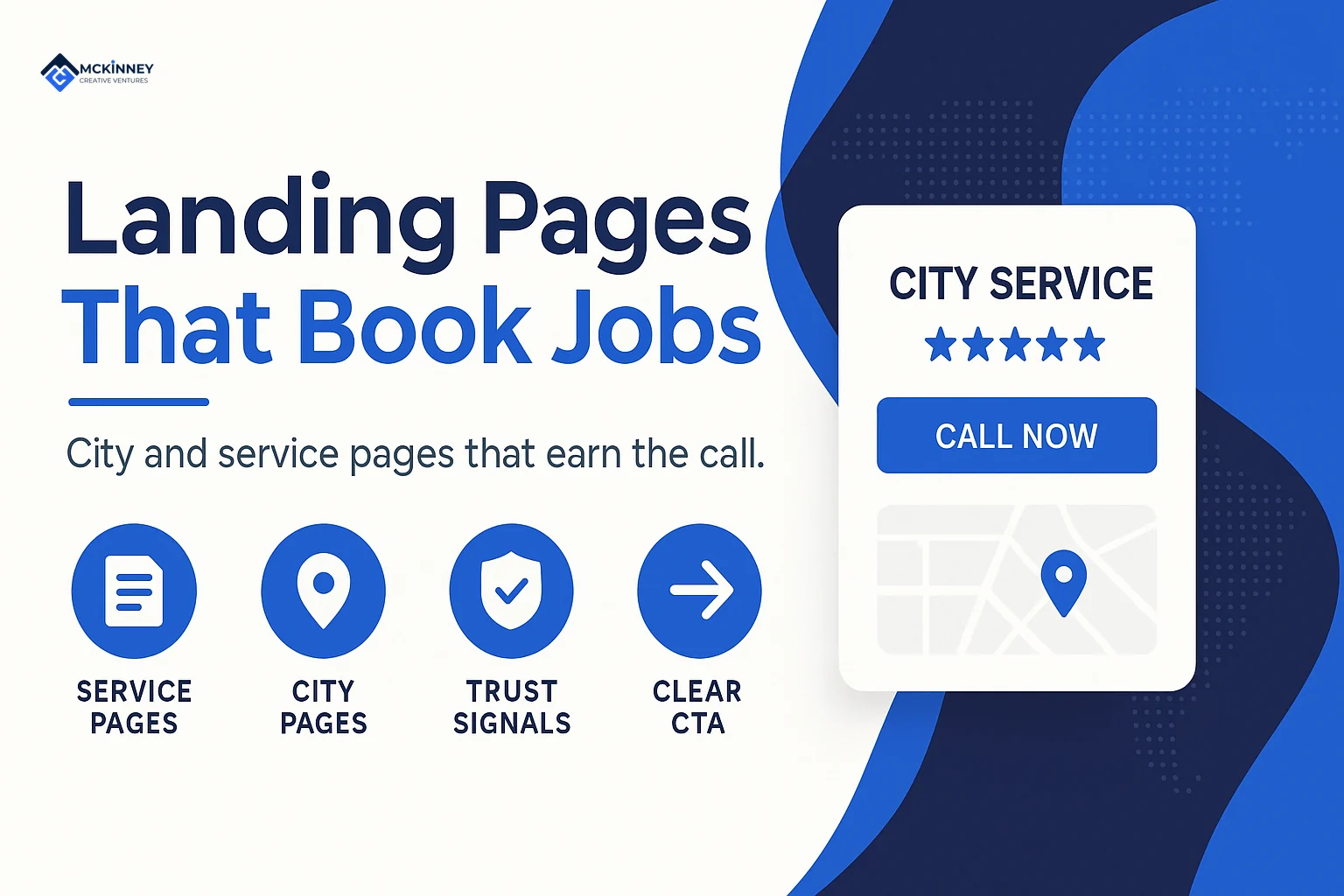
Local landing page best practices come down to one rule: a page for a city or a service has to be useful on its own, or it should not exist. A page that swaps a city name into a shared template risks matching Google's description of doorway abuse, and it gives the customer nothing to act on. A page that answers what someone in one specific city needs, from a business that works there, is a real asset. This guide is for contractors, clinics and shops in the Twin Cities East Metro, the St. Croix Valley and western Wisconsin.
In our experience, some service businesses publish twenty city pages in a weekend, see no calls, and decide local SEO does not work for their trade. The pages are usually the cause, because they say the same thing twenty times. Below are the architecture, trust signals, technical layer and build order we recommend for local pages, the kind of work our website design service covers.
Local landing page best practices start with the doorway test
Before layout or copy, a page has to pass one test. Google's spam policies define doorway abuse as pages "created to rank for specific, similar search queries" that "lead users to intermediate pages that aren't as useful as the final destination." One of its examples is "having multiple domain names or pages targeted at specific regions or cities that funnel users to one page" (Google Search Central, spam policies).
In our reading, the policy describes near-identical pages that exist to catch a query and push the visitor to one generic form. If your Woodbury, Stillwater and Hudson pages differ only in the town name, they fit the description. If each carries information a person in that city cannot get from the other two, it is a legitimate page that happens to be local.
The same page defines scaled content abuse as many pages generated "for the primary purpose of manipulating search rankings and not helping users," and says that applies "no matter how it's created." Its examples include using generative AI tools to generate many pages without adding value for users.
The practical test is blunt. Delete every instance of the city name from the draft. If you can still tell which city the page is about, it has local substance. If you cannot, it is not ready.
The architecture: a service layer, a city layer and a service-in-city layer
The common mistake is treating local pages as a list of towns. A better model is three layers that do different jobs, built in order.
Scroll to see all columns
| Layer | Example page | Search intent it serves | What makes it unique | Minimum bar to publish |
|---|---|---|---|---|
| 1. Service | /services/water-heater-replacement/ | What the work involves, what it costs, who does it | Your actual process, pricing model, equipment and warranty | Complete enough that a customer could hire you from this page alone |
| 2. City | /service-areas/stillwater-mn/ | Do you really work here, and do you know this place | Local conditions, permitting, licensing, named staff, local proof | At least three facts true of this city and false of the next one |
| 3. Service in city | /water-heater-replacement/stillwater/ | High intent, ready to book, comparing two or three names | How that service plays out in that specific city | Only where real search demand and real job volume both exist |
Layer one carries the weight
The service page holds the substance: the work, the sequence, what it typically costs and why the range is a range, what materials you use, and what happens if something goes wrong. Everything downstream borrows credibility from it, so a thin service page cannot be rescued by city pages. Useful service pages and accurate business information are the foundations our SEO, GEO, and AEO service works on.
Layer two proves you are local
A city page is an argument that you belong in that town. The strongest material is place-specific and checkable: which municipality issues the permit and what it asks of contractors, who on your crew lives there, and photos of jobs you did there. East Metro towns sit close together and still differ on permits, and the St. Croix is a state line.
Woodbury's Building Permits and Inspections page says the city uses a combination permit system for projects such as additions, basement finishes, decks and remodels, and that residential contractors and subcontractors must hold a valid Minnesota state license or mechanical bond (City of Woodbury). Hudson sits across the river in Wisconsin. Its building permit information sheet, whose first page is dated February 3, 2021 and whose second page is dated January 14, 2026, says the city requires no local contractor registration, credential or license, says the state may require one, and lists Wisconsin credentials by trade, including a Master Plumber License for plumbing contractors (City of Hudson). A contractor serving both towns has two licensing stories, and a page for each can tell its own. Confirm current rules with the city and the state agency before you publish them.
Layer three is earned, not assumed
Five services across fifteen cities is seventy-five pages, and in our experience few businesses have seventy-five pages of distinct things to say. Build these only where you can point to real search demand and a real book of jobs.
What has to be on the page before someone will call
Arguments about landing pages tend to be arguments about design. BrightLocal's July 2026 research on what makes consumers choose a business surveyed 1,227 US consumers who had searched online for a local business in the previous three months, and asked them to rank the factors that influenced which business they decided to contact or visit. Counting the share who put each factor in their top three, clear and complete information (hours, address, phone) came first at 32 percent, the most or best reviews second at 30 percent, and clear pricing or a deal or offer third at 29 percent (BrightLocal, what makes consumers choose a business). None of those is a visual choice.
Scroll to see all columns
| What the searcher needs | What that means on the page | The common failure |
|---|---|---|
| Clear, complete information | What you do, where you do it, hours, service area, licensing, what happens after they contact you | Service area listed as "the Twin Cities and surrounding areas" with no actual list |
| Reviews they can see | Real reviews with names and dates, on the page, near the point of decision | A star rating graphic with no source, or a reviews page nobody visits |
| Clear pricing | A range, a starting price, a flat rate, or an honest explanation of what drives the number | "Contact us for a quote" as the only pricing signal on the site |
| Proof you work here | Named jobs, local photos, staff who live in the area, local references | Stock photography and a generic map graphic |
| An obvious next step | One primary action, repeated, above and below the fold | Six competing calls to action and no clear hierarchy |
In our experience, pricing draws resistance from owners, and the objection is fair because every job is different. The answer is to publish the shape of the number: a starting price, a typical range, and the variables that move it. That gives the reader what the BrightLocal list points to, and in our experience it screens out calls you did not want.
Trust signals that carry weight locally
In our experience reviews do much of the work, and the bar is moving: BrightLocal's Local Consumer Review Survey 2026 found that 68 percent will only use a business with four or more stars, up from 55 percent in 2025 (the page states both; BrightLocal, Local Consumer Review Survey 2026). The survey, published in February 2026 with 1,002 US adult consumers, also found that 74 percent only care about reviews written in the last three months. Asked which actions they were likely to take after reading positive reviews, 54 percent said they then check the business's website. Respondents could pick more than one action (BrightLocal, Local Consumer Review Survey 2026).
More than half of those readers go on to a website, so the landing page is the second half of the same decision, and strong reviews on top of a vague page lose the customer at the handoff. Keeping recent reviews coming in is its own system, covered in how to build a review generation system.
Beyond reviews, the signals that move a local buyer are plain and specific:
- Named people. A first name, a role and a face give the customer someone to ask for.
- License numbers, printed. The actual number, which a homeowner can look up with the state, beats a badge graphic. Minnesota's statute on license numbers (Minn. Stat. 326B.87) says the license number of a licensee must appear in any advertising by that licensee, websites included (Minnesota Revisor of Statutes). Which license your trade holds decides whether the section applies to you, so check with the Department of Labor and Industry.
- Specific proof. A photo or short description of a job you did in that town beats "trusted by homeowners across the metro." Use only numbers you can back up.
The technical layer under a local landing page
Structured data, done accurately
Google's LocalBusiness documentation lists two required properties, name and address, and recommends others including geo, openingHoursSpecification, telephone, url and priceRange. It says you can add the markup to any page on your site, though it may make more sense on a page with information about your business, and to use the most specific LocalBusiness subtype available. It also says the aggregateRating property is only recommended for sites that capture reviews about other local businesses. In our reading, that means a plumber's own site should not copy its review count into that property (Google Search Central, LocalBusiness structured data). Mark up only what is visible on the page.
Speed, measured the way Google measures it
web.dev says sites should strive for a Largest Contentful Paint of 2.5 seconds or less, measured at the 75th percentile of page loads and segmented across mobile and desktop (web.dev, Largest Contentful Paint). The measurement is the slowest quarter of your visitors, which a fast test on office wifi will not show. Phones matter here: in BrightLocal's July 2026 research on search channels, 73 percent of 1,227 US consumers said their latest local business search started on a phone (BrightLocal, search channels).
One job, one URL
Confirm every page is indexable, linked from your navigation and not competing with another page for the same query. Two pages fighting over "water heater repair Woodbury" is a self-inflicted problem.
Conversion mechanics: turning the visit into a job
- One primary action, repeated. Pick call or book, then place it in the header, after the proof and at the end.
- The phone number is a real link. A tel link on mobile, visible without scrolling.
- Forms ask for the minimum. Name, phone and what they need. Every extra field costs submissions, and you can ask the rest on the call.
- The form goes into a system. A submission landing in an unwatched inbox is a lead you paid for and lost.
- Response time is part of the page. The page's job ends when the form submits. The job it was built for ends when someone answers, which is why speed to lead decides the outcome.
The order to build it in
Sequence matters because each phase makes the next cheaper. This is the order we suggest for a local service business.
Scroll to see all columns
| Phase | What you build | Why it comes here |
|---|---|---|
| 1 | Complete service pages for every service you actually sell | Everything downstream borrows substance from these |
| 2 | Conversion layer: calls to action, tel links, short forms, CRM routing | No point driving traffic into a page that cannot capture it |
| 3 | Three to five city pages for your highest-volume markets | Prove the format works before scaling it |
| 4 | Trust layer: reviews on page, named staff, license numbers, real photos | Lifts conversion across every page at once |
| 5 | Structured data and speed work | Cleans up pages that already deserve to rank |
| 6 | Service-in-city pages, only where demand is proven | The highest-intent pages, built last and built selectively |
Mass city page production is not phase one, and for many businesses it never becomes a phase at all. Give new pages a full quarter before judging them: impressions show the page is seen, form submissions show it converts, and booked jobs show the traffic was right. If your site already has a pile of city pages that never produced a call, book a strategy call and we will review which pages your business can support.