
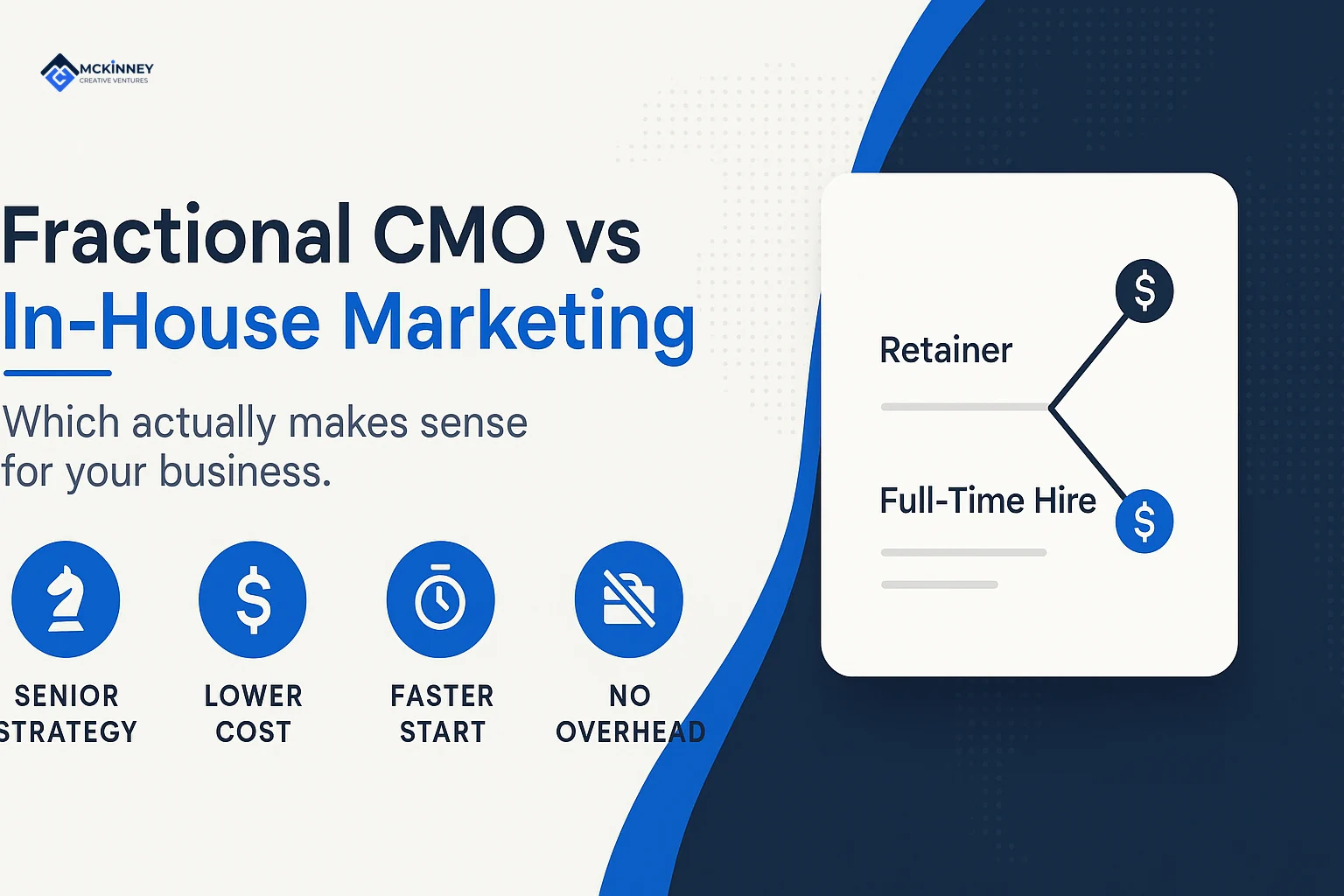
Fractional CMO vs in-house marketing comes down to how much senior marketing direction your business needs and how much steady work there is to keep a full-time person busy. A fractional CMO gives a small business a part-time marketing leader who sets direction, priorities and measurement. A full-time hire gives you one person who is yours every day, with the salary and management that come with it.
This guide is for owners of local service businesses and small firms in the Twin Cities East Metro, the St. Croix Valley and western Wisconsin who are deciding between a fractional CMO, a full-time marketing leader, a coordinator, an agency, or keeping marketing on their own plate. It compares them side by side, explains the "VP of Growth" question, and uses public wage data where a number is needed. It is general business information and is not tax or legal advice.
Fractional CMO vs In-House Marketing: The Short Answer
In our experience, many small businesses do not have a full-time job's worth of marketing leadership to hand to one executive. They have a handful of decisions that matter a great deal: which services to push, where to spend, how to track a lead to a job, and what to stop doing. A fractional CMO is built for that gap. An in-house leader makes sense once the volume of work, the size of the team and the budget justify a person whose whole week is marketing.
Three questions settle most cases.
- Is there a leader's worth of work every week? If the honest answer is a few hours of planning and review, a full-time executive will end up doing tasks they are overqualified for.
- Who will do the work once the plan exists? A strategist without a writer, a designer or an agency produces a good plan and little else.
- Can you manage this person? Every option on this page needs an owner or manager who can say yes, no and not yet, and read the results.
What a Fractional CMO Does
We know of no license or official definition for the title, so what follows is our description of common usage. A fractional CMO is an experienced marketing leader who works for several companies at once, or for a few, on a set scope. The usual job is to set the strategy, choose the channels, decide the budget split, define how results get measured, and direct whoever does the work, whether that is a coordinator on your payroll, freelancers or an agency.
The scope is the part to pin down in writing. One fractional CMO owns the plan and the reporting without writing a single ad. Another also manages a vendor or two. They are priced and judged differently, so ask which one you are buying.
What it does not replace
Someone still has to write the pages, answer the form submissions and run the ads. Our post on outsourced marketing support covers what to hand off and what to keep, so we will not repeat that list here.
Fractional CMO vs VP of Growth
Owners searching for a fractional CMO vs a VP of Growth are usually asking whether the two jobs are the same. The titles overlap and companies use them loosely. This is our description of common usage, and it is not a sourced definition.
- Scope. A CMO usually owns marketing: positioning, brand, channels, content, and how marketing is measured. A VP of Growth is more often handed a revenue outcome, such as new customers or repeat business, and works across marketing, the website, pricing, onboarding and sometimes sales.
- Accountability. A VP of Growth is typically held to a number. A CMO is held to the quality of the marketing system and what it produces, which often includes a number but not always the same one.
- Time. A VP of Growth is normally a full-time employee. A fractional CMO is part-time by definition, and some work as independent contractors.
- Fit. A VP of Growth suits a company with a product, a funnel and enough data to run experiments every week. A fractional CMO suits a business that first needs a plan, a message and a way to measure.
In our experience, the practical difference for a local service business is the amount of data. A growth role depends on enough leads and customers to test against. A contractor or clinic with a few dozen inquiries a month rarely has that, so the strategy and measurement work of a CMO usually comes first.
How a Fractional CMO, a Full-Time Hire, a Coordinator, an Agency and DIY Compare
The table sets the five common options next to each other. It leaves out prices on purpose, because they vary by person, scope and market, and a figure we could not source would only mislead.
Scroll to see all columns
| Option | What it owns | What it needs from the owner | When it fits |
|---|---|---|---|
| Fractional CMO | Strategy, priorities, budget direction, measurement, direction of vendors and staff | A standing meeting, access to sales and job data, and decisions made quickly | You need senior direction but not a full-time executive, and you have people or vendors to do the work |
| Full-time marketing leader | All of marketing, plus hiring and managing the team below | A real budget, a defined target, and a manager who can evaluate the work | Marketing is large enough to fill a leader's week and there is a team or agency to lead |
| In-house coordinator | Day-to-day tasks: posting, email, listings, reviews, reporting | A plan and priorities from someone else | The strategy exists and the tasks need a steady owner |
| Agency | A defined set of services, such as ads, SEO or a website, and the reporting on them | Fast answers, approvals, and a clear definition of a good lead | You want skilled production across several disciplines without hiring each one |
| Owner doing it | Everything, in the gaps between jobs | Time, which is the scarce part | Early stage, very small, or a business that grows by referral |
The options can be combined: a fractional leader sets the plan, a coordinator runs it day to day and an agency handles specialist work. Our services page lists the website, search, advertising, CRM and brand work we do on the specialist side of that mix.
What Each Option Costs
The wage floor for a full-time hire
For a full-time leader, the U.S. Bureau of Labor Statistics Occupational Employment and Wage Statistics for May 2025 list a Minnesota median annual wage of $173,300 for marketing managers. That is a median wage for an occupation group. Benefits, payroll taxes, software and recruiting sit on top of it, so it understates the cost of employing someone, and it says nothing about any particular hire.
BLS describes the work in its Occupational Outlook Handbook: advertising, promotions and marketing managers "plan programs to generate interest in products or services," and most work full time. We used marketing managers as the closest occupation we could find to a CMO. A CMO title may be paid differently, so treat the figure as a reference point. Our post on digital marketing cost for small business uses the same BLS Minnesota medians for other roles.
How fractional work is priced
We did not find a public survey of what fractional CMOs charge, so we will not give a range. The usual structures are a monthly retainer for a defined scope, a block of hours per month, or a fixed-term project such as a strategy and plan. Whichever you choose, ask for the scope, the meeting rhythm, the reporting, the term and how you exit, in writing. A lower monthly number that buys little decision-making is not cheaper than a higher one that does.
The contractor question
In our experience, many fractional leaders work as independent contractors, and whether that holds up depends on the whole relationship. The IRS page on independent contractor or employee says businesses must weigh behavioral, financial and relationship factors, and that no one factor stands alone in that decision. If you plan to direct a fractional leader's hours and methods the way you would an employee's, talk to your accountant or attorney first.
When a Fractional CMO Fits and When It Does Not
Signs a fractional CMO fits
- You spend money on marketing but cannot say which source produces booked jobs.
- Several vendors work on separate pieces and nobody sets priorities across them.
- The business is growing past what the owner can steer, and the owner is the bottleneck on every marketing decision.
- There is a coordinator, a freelancer or an agency ready to carry out the plan.
Signs a full-time hire fits
- Marketing work fills a leader's week, every week, and has for a while.
- The company has a budget and a team or agency relationship that needs daily direction.
Signs neither is the right first step
If the website does not convert, leads are not tracked, or nobody answers the phone quickly, a senior strategist will mostly tell you to fix those. Start with the basics: a site that books the job, a record of where each lead came from, and a fast first reply. A coordinator or an agency can handle the tracking and follow-up setup while the plan takes shape.
Fractional CMO vs Full-Time Hire in Minneapolis and the Twin Cities
Owners in Minneapolis, St. Paul and the East Metro ask the same question from different starting points, and the comparison does not change with the city. What changes is the local labor market and the shape of the business. The BLS wage data above is statewide for Minnesota, so it does not separate Minneapolis from the St. Croix Valley or from western Wisconsin, where the numbers can differ. Seasonality matters too. A roofing or landscaping company in Woodbury or Hudson has a different marketing calendar from a clinic or a law firm.
McKinney Creative Ventures is based in Woodbury and works across the Twin Cities metro. We do not have a Minneapolis office. Our professional services page lists "Business Strategy and Fractional CMO" and describes it as strategic growth advisory for firms scaling past the founder-dependent model into systematic business development. We also run an agency, so we have an interest in this comparison. That is the full description we make here, and we do not set a price or a fixed set of deliverables in a blog post.
Questions to ask any fractional CMO
- Which parts of the plan will you write, and which will you direct others to write?
- Who owns the accounts, the ad budgets, the analytics and the content when we part ways?
- How will you measure results in our CRM, and how often will we review them?
- How many other clients do you handle, and how do you respond when something is urgent?
If you are weighing these options and want to talk through your own numbers, get in touch with McKinney Creative Ventures.