
Choosing a marketing agency is a hiring decision, and in our experience many local agencies fail their clients for reasons you can spot before you sign. This guide is for owners of service businesses in the Twin Cities East Metro, the St. Croix Valley, and western Wisconsin who are about to hire an agency, or who already have and are not sure it is working.
One disclosure up front: McKinney Creative Ventures is a marketing agency based in Woodbury, Minnesota, so we have an interest in this topic. Hold us to the same questions we list below. The advice does not depend on which agency you pick, and some of it will send you to a competitor if that is the better fit.
Scroll to see all columns
| Question to ask | A good answer sounds like | A red flag sounds like |
|---|---|---|
| Who will run my account day to day? | A named person, their role, and how often we meet | "Our team handles it" with no names |
| What do you report on? | Calls, booked jobs, cost per lead, and what each source produced | Impressions, followers, and "reach" |
| Who owns the accounts and data? | You own the ad account, Business Profile, analytics, and domain from day one | "We set it up under our account" |
| What happens if I leave? | Written terms, a notice period, and a handoff of every login and asset | Silence, or fees for releasing your own data |
| How do you handle the leads you generate? | A plan for call answering, text follow-up, and tracking to a booked job | "Leads are your side of the fence" |
| What do you know about my market? | Specific local detail: your service radius, your seasons, who you actually compete with | A generic plan that could be pasted into any city |
Why many local marketing agencies fail their clients
In our experience, agencies do not usually fail because the people are careless. They fail because of how the business is built. An agency earns a monthly fee for each account, so the pressure is to sign more accounts, spread each person across many clients, and report numbers that look good every month. None of that is aimed at your phone ringing.
The result is a set of repeating patterns. The account is sold by a senior person and handed to a junior one. The plan is a template with your business name dropped in. The monthly report celebrates impressions and clicks while nobody checks whether a single call became a job. And after the first month of onboarding energy, contact thins out. If you recognize a pattern in your current agency, the problem is structural, and a friendlier account manager will not fix it.
The failure modes worth screening for
- Tactics without a strategy. Ads, a blog, and a few social posts all running, with no agreement on which customers you want or what a good month looks like.
- Channels that do not talk to each other. The ads team sends traffic to a page the SEO team never saw, and nobody owns the handoff to your phone.
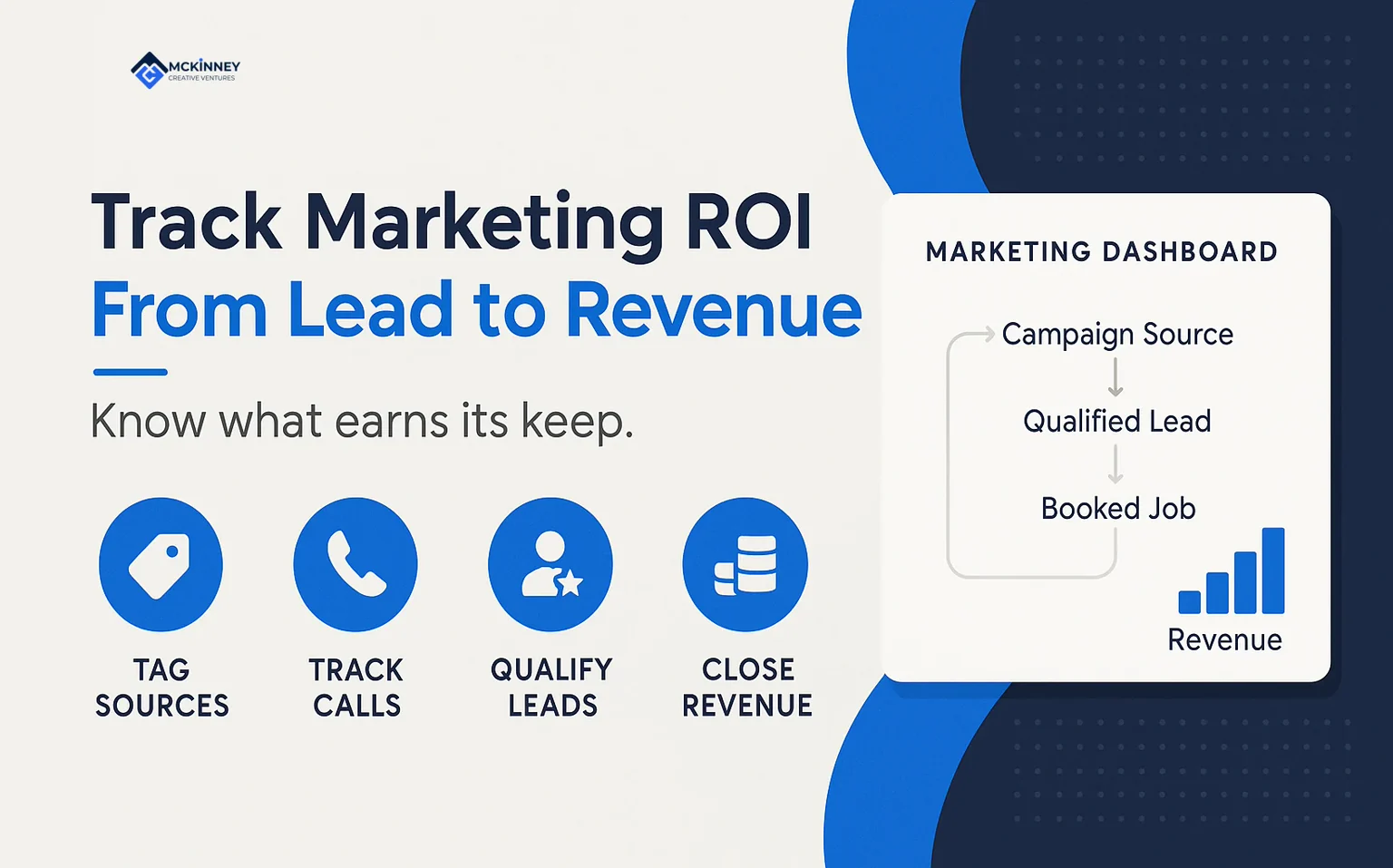
- Vanity reporting. Numbers that go up whether or not you earn more. Ask for booked jobs and revenue by source.
- No lead handling. Leads arrive, sit unanswered for hours, and the agency calls it a client problem. Speed matters here, and we cover it in our guide to speed to lead for service businesses.
- Disappearing after onboarding. You get a kickoff call and then a PDF each month.
Choosing a marketing agency: the vetting checklist
You do not need weeks of pitch calls. You need a short, consistent set of questions asked of every agency on your list, so the answers can be compared. The table above is the core of it. A few points deserve more detail.
Ask who does the work, not who sells it
Ask to meet the person who will actually run your account, and ask how many other accounts they carry. A specialist spread across a few clients can give each real attention. One spread across dozens cannot. A good agency will answer directly. A weak one will talk about "the team."
Ask what a good month looks like in your terms
Before any proposal, an agency should ask you what a booked job is worth, which services you want more of, and how many calls your crew can handle. If the first pitch talks about traffic and rankings before it mentions your jobs, the agency is selling activity. You are buying outcomes.
Ask for a reference you can call
Ask to speak to a current client with a business like yours, and one who has left. A confident agency can name both. Be cautious about glossy case-study pages with no named client, and about any agency that cannot put you in touch with a real person. Do not treat an award badge or a directory listing as proof. A badge or listing may reflect a paid profile, so ask what it actually measured. It says little about your results.
Who should own your accounts and data
This is an expensive thing for owners to discover too late. Your Google Business Profile, Google Ads account, website, domain, and analytics should belong to you, with the agency given access, never the other way around. If the agency owns them, leaving the agency means starting over.
Google's own help pages show how this is supposed to work. On a Business Profile, owners have full control and managers have nearly the same access, except that managers cannot add or remove users or remove the profile. A profile can have more than one owner but only one primary owner, so make sure the primary owner is you or someone in your company, and give the agency manager access. In Google Ads, a manager account can become the owner of a client account, but the client account can always unlink a manager with ownership. That is the control you want to keep. Ask each agency on your list to confirm in writing how they set this up.
Two more items belong on the same list. Ask for the domain registration to be in your name, and ask for administrator access to your analytics and call tracking. If you ever leave, those should be a setting change and not a negotiation.
What a good agency does differently for a local service business
A local service business sells to a defined area, in specific seasons, usually on a phone call. An agency that understands that behaves differently from a generic one, and the differences are easy to test.
Local market knowledge you can verify
Ask how the agency would handle your service radius. For a business that travels to customers, Google's guidelines say a service-area business should hide its address and set a service area, and that the area should not stretch beyond about two hours of driving time from the base. An agency that has not worked with a service-area profile may suggest listing a home address or claiming a dozen cities you do not serve. In a market like the Twin Cities East Metro, where a Minnesota business may take jobs across the river in Wisconsin, ask how they would set up the coverage so it matches where your trucks actually go.
Seasons matter too. A plumber, an HVAC company, and a landscaper in Minnesota do not have the same busy months, and a plan should reflect yours. If you want to see what planning around local seasons looks like, our seasonal marketing calendar for Minnesota service businesses shows the method.
Meeting in person is a real advantage
A nearby agency can walk your shop, ride along on a call, and meet your office staff. That is not required, and plenty of remote agencies do excellent work. But if your business depends on how calls are answered and how jobs are scheduled, someone who can see that process learns more in an hour than a form can tell them. Ask what the agency will do to learn your operation and how often you will talk, and whether in person is an option when you need it.
Connected systems, not separate services
Ads, search, the website, and your CRM have to work as one system. The page an ad lands on, the call that follows, the text sent when you miss it, and the review request after the job are all part of the same result. We build this way on purpose. Our CRM and automation service exists because we do not think it makes sense to buy leads before you can catch them. Whatever agency you hire, ask how it plans to connect marketing to what happens after the lead arrives.
Contracts, timelines, and when to walk away
Contract length is a negotiating point, not a moral one. A longer term can be reasonable when the work involves a build, such as a new website. For ongoing marketing, look for a notice period you can live with, a clear scope for each month, and no penalty for taking your accounts back. Read the cancellation clause before the scope of work.
Timelines depend on the channel, and a good agency will say so honestly. Paid search can produce calls soon after launch, but the first weeks are mostly learning what works. Search engine optimization and site builds take longer to show results. Be wary of anyone who promises a ranking or a number of leads, because no one controls those. Google's own guidance says no one can guarantee a number one ranking and advises finding someone else if a provider does. The same page suggests asking a prospective provider for examples of previous work and whether they will share every change they make to your site. Those are good questions for any agency.
Reasons to leave an agency
- You cannot get a straight answer on where your leads came from.
- The agency will not give you access to your own accounts.
- Reports have changed from jobs to impressions without explanation.
- Your contact has changed three times and no one knows your business.
Before you leave, ask for written access to every account and an export of your data. Then give the next agency the same questions you used on the first one.
Should a marketing agency specialize in one industry?
Owners often ask whether to hire an agency that has niched down. There is a fair argument both ways. A specialist knows your customers, your seasons, and your competitors, and can move faster. A generalist brings ideas from other fields and is not tied to one industry's habits. The question to ask is not whether they specialize, but whether they can show they understand your type of customer and your sales cycle, and whether their work for you is built on your numbers or a template. A niche agency that sells the same template to everyone in its niche has the same flaw as any other agency.
Coaching and consulting businesses ask a similar question about agencies that claim to serve them. The same checks apply: ask what the agency actually knows about how your clients buy, and see whether the plan reflects that or a generic funnel.
If you want to compare notes on what to look for before you hire anyone, including us, contact McKinney Creative Ventures and bring your questions.